Affichage des articles dont le libellé est separatist-critique. Afficher tous les articles

mercredi 27 février 2019

House of Lords passes the Dutch on the left hand side

 from the department of the eternally hosted comment

I'm something of a Carlton Reid fan—I buy his books anyway—and I'm full of admiration for the tenacity of his career as a journalist covering the cycle business. He is to my view somewhat over-enthusiastic about the merits of separatist cycle infrastructure, but this is a matter for reasonable debate, and at least he does actually ride a bike. So I'm inclined to forgive him when I revisit his site bikebiz.com, and find that a comment that I left on a story he wrote in April 2017 about some clueless peer's ignorant waffling in the House of Lords has disappeared. Comments often seem to be the first casualty of website design makeovers, and in this case archive.org seems not to have come to my remarks' rescue. So here they are again, now with illustrations.
This idea of the Netherlands as some sort of transport paradise really does need a dose of reality. Firstly, while their overall road mortality compares favourably with that of other European countries, they're hardly immune to road deaths.
All European countries observed a decline in cycling as cars became widely available in the sixties and seventies. While the Netherlands are to be congratulated for arresting this decline better than most, they have not grown cycling since.

Yet in global terms they do occupy one of the most favourable topographies for cycling on the planet.The solution they found back then—of rigid separation of modes—has its virtues, but cannot be unquestioningly adopted in other localities—might hills make a difference for example?
Since the seventies, motorists have not improved their reputation: the ongoing road slaughter, oil wars, an obesity crisis, and pollution episodes can all be laid directly at their door, even before we consider the contribution of motoring to anthropogenic climate change. More thoughtful parliamentarians would be considering how to kick the motors out altogether, not bleating about a few cycle paths.

This seems a good place to note that I consider the House of Lords to be an insult to the notion of democracy, and I'd sack the lot of them if I could. Confronted with such evident idiocy in the legislature, it is natural to wonder how the hell to get rid of one. Answer: you can't. Dictators Peers for life! Ho hum!

jeudi 22 juin 2017

Another look at Dutch geography as it pertains to cyclists

from the polder layout department

The Netherlands are often held up as a model for good practice in cycle policy. I've made the point already that the country has a number of geographical peculiarities which mean that its methods should be interpreted with caution when considering generalizing them elsewhere. Of course it is possible, indeed more enjoyable, to ride a bicycle in more hilly terrain than any the Netherlands has to offer. But the techniques required by both the cyclist, and the urbanist seeking to encourage them, are self-evidently going to be different. This much is obvious.
But there are a couple of more subtle points to l'exception néerlandaise that have occurred to me since my pilgrimage to Groningen last year:


a map of 20th century Dutch polders
20th century polders, from Hoeksema (2007)
1) Fully 5% of the Netherlands' land surface area has been added to the country between 1930 and 1968. This often seems to have been landscaped à l'américaine, with spacious boulevards that admit complete modal segregation between facing frontages as much as 100m apart. Time pressures obliged me to admire the splendour of the Almere suburb from the window of a train rather than from the bike, but the desire to allocate huge reserves of space to the motorist there was plain enough, as one would expect from any bunch of 1970s planners anywhere.

2) In a country where for centuries the canals have been the main axis of transport between towns, it may be that it seems quite natural to have a "major" and "minor" towpath. I noticed on my trip last May that very often I received strong cues from the urbanists to travel on one side of a canal-line (which was often a mixed-use low-speed residential street), while across the water I could see cars moving quite fast on a higher speed street. I was cool with that as long as getting to the "right" side didn't take me too far out of my way. As a tourist, naturally I just went along with it, but I could imagine being a local resident with a bike and being daily pissed off by the tortuousness of the route I was obliged to follow. (Obligatory) cycle routes along major trunk roads often jink from one side of the motorway to other, adding significant travel distance perpendicular to the desired direction. This sucks.

We should be clear about all these distinctions when considering the applicability of Dutch cycle infrastructure design to other parts of Europe, where the width of roads and streets (their frontage-to-frontage distance) was determined in the era of horse-drawn vehicles. Horses go home at night, and the carts they were pulling too. So three cart-widths would be pretty much enough anywhere: one delivering, two passing in either direction. On-street parking is a twentieth century curse. Where such conditions exist historically in the Netherlands, they tend to mostly exclude motor traffic (as of course you should). Parallel universes of "protected cycleways" may be an option in new towns and suburbs, but in the vast majority of European cities the nettle of private car dependence must be grasped.

mercredi 11 novembre 2015

Is cycle infrastructure the new helment?

from the new-Fordist-distractions department


The open access arm of the BMJ has just published the results of an ecological study from Canada, where legislators have created an interesting natural experiment by requiring cyclists to wear helmets in some provinces, but not others. The authors claim surprise that they found no effect in either the overall injury rate or the head injury rate between the provinces, though those of us who have followed what BikeSnobNYC calls the helment (non-)issue are perhaps less surprised. Forced by their negative results to admit helmet legislation has no effect on the substantive issue--reducing danger for cyclists--the authors then proceed to claim that "more cycle infrastructure" is the solution. Although they review the literature, they themselves have no data to add, and as the issue of road design and behaviour is fraught with complication, conflicting interests, and perverse effects, I thought they weren't entitled to a free pass at their sweeping and not altogether well-founded discussion.
As ever when someone is wrong on the internet, I freely composed a comment for the delectation of both the authors and the public. This the BMJ have failed to publish, so, in the best traditions of this blog, it appears here:
These are valuable results and the authors are to be congratulated on their clear presentation.
Given the health and well-being effects of regular cycling, the overall risk of hospitalisation of 622/100 million trips is worthy of wide attention: a chance of ~1 in 160,000 that your trip will end in hospital rather than your intended destination is really rather low, even in the present motor-dominated environment.
However, the recommendation by the authors that more "bicycling infrastructure" is the answer to increasing modal share, thereby augmenting the "safety in numbers" effect is controversial, and is neither justified nor refuted by the evidence presented here. (Cyclists were asked about whether they used their bicycles, not about the routes they took).
My own view is that developed countries already have a highly developed infrastructure that is ideal for cycling called the roads, and that the real problem is negligent driving. Some design features that privilege more direct routes for cyclists and exclude excessive motor traffic (cycle contraflows, modal filters, bicycle boulevards) may be useful, but the real enemies remain excessive speed and drunk driving, and the newer menace of distraction by mobile devices.
Effective measures to reduce these, including stricter policing, driver education, strict civil liability for drivers who collide with cyclists, and proper accident investigation to ensure lessons are learnt, are more important elements for those who would emulate (and surpass) best European practice.
I shall footnote this comment with two more:
1) I am surprised and disappointed at the BMJ's failure to publish the comment in situ, though I suspect this reflects organisational failure to monitor the relevant disqus account rather than any conspiracy to silence me.
2) I suppose it is not surprising that people deluded into a focus on the victim-blaming issue that is cycle helmet promotion and compulsion, will, brought to their senses by the lack of supporting data, switch their allegiance to the unicorn of "cycle infrastructure," instead of the elephant in the room of much-needed motor traffic reduction, better driving-related laws, enforcement thereof, and driver education. These present real challenges of course: but addressing them is what's needed, not demands for a parallel reality of "cycle infrastructure" before cycling can be widely adopted.
And given that such infrastructure is often second-rate while delegitimizing existing cyclists' right to the road, they may be assured that this cyclist at least, will keep calling them out, until his dying breath has been finally drawn.

lundi 5 octobre 2015

Separate development? Or civilised behaviour?


I recently commented on a Guardian article discussing recent deliberate attacks on cyclists in the UK, which uncritically presented the statement:
building segregated bike lanes [is] proven to be the best way to prevent such deaths
 I reproduce it here, for ease of navigation:

***
Reference required? It is rather a controversial matter. It is true that the countries where extensive segregation of cyclists has long been practised (Denmark, the Netherlands) have markedly better safety records than their neighbours. They are no paradise though: there are still 200 cyclist deaths a year in the Netherlands, for example.
But their segregated networks have been obtained at a certain price: the exclusion of cyclists from many parts of the road network (and its superior surfaces and direct travel lines), and slow and complicated junctions.
A Canadian study has showed higher accident rates for cyclists who habitually use footpaths rather than the carriageway. Most collisions happen at junctions. Footpath (and cycle lane) users generally find themselves at a positional disadvantage with respect to the traffic flow just when they most need to be correctly positioned.
A pre-eminent Dutch road safety expert has just published a paper (paywall, sorry) admitting that, in part, his country's superior cycling safety record is because their cyclists ride more slowly. They have to, on often tight cycle paths. Waits at complicated junctions can be long too.
Building cycle paths does reduce the space available for other modes. Such paths are the cowardly choice of the policymaker too timid to confront head-on the reality that the private motor vehicle is a dysfunctional form of urban transport, but nevertheless would, understandably, appreciate less noise, pollution, danger and fewer parking spaces in their town centre.
It has little to do with increased road safety for cyclists though: in fact, life for the cyclist may well be more difficult after they have been implemented, though if this also means fewer motor vehicles in town, this may be nicer for everyone.

***
Here's a video from the UK of the kind of angry entitlement we can expect from motorists once a cycle path, however unsatisfactory, has been built alongside a main road. Talk about realpolitik! (Cyclists in the UK retain their right to ride on the road, and are not obliged to use any cycle path.)

***

Thanks to the authors of these tweets for inspiring this post:

samedi 1 août 2015

On the road to cycling hell

This is a translation of an original post I published in French here.

"Be careful what you wish for: it might just come true one day..."

We, as London cycle activists, were always careful not to fall into the pockets of the road engineers and planners, whose responsibility was always for "the possible." We, on the other hand, were struggling with "the impossible"—the end of car culture in town, with its impossible demands for space, its danger and pollution. My vision is still to reclaim the roads for the cyclist, and leave the pedestrian unmolested on the sidewalk. And the Dutch method of "cycle apartheid" has absolutely damn-all to do with promoting cycling; rather it is a dangerous source of oppression.

It's true that planners can do useful things for cyclists: allowing cycle contraflows in one-way systems for motor vehicles (the principle of cycle permeability), and reducing speed limits on roads where necessary. But if each "advance" is accompanied by a degradation, such as, for example, the appearance of "No cycling" signs on roads with cycle paths alongside, one begins to doubt the good faith of the authorities. (This happened in 2012 around Nantes, on the D69 between Nantes and Sucé-sur-Erdre, the D75 between Indre and St. Herblain, and the D107 between Chantenay and Indre).

So I went to a meeting organized by Place au Vélo (Nantes' most significant cycling organisation) to hear a talk by the author and transportation journalist Olivier Razemon yesterday evening, and to criticize their strategy.
I spoke up against this pavement cycling (and separatist infrastructure) during the meeting.

I began my remarks by quoting the aphorism "The road to hell is paved with good intentions", and my opinion that, in the seven years I have lived in Nantes, conditions for cyclists have worsened. And I read an extract from Olivier Razemon's latest book to illustrate the true problem which prevents sharing the road:
"We've all met, at least once, an arrogant, overweight driver, steering wheel in one hand, the tyres of his 4x4 squealing, as he accelerates towards pedestrians, while giving the finger to cyclists."

(They're certainly more common in England, hence my preference for life in France! And the beautiful strict liability law—the loi de Badinter—passed in 1985, gives strength to the cyclist's elbow as well). And I asked Olivier Razemon, and the auditorium in general, if we were ignoring the true problem, that he so expertly describes, whilst scrabbling round in the details of local authority expenditure on street design, with €80 millions budgeted to the year 2020, etc, etc.? Behavioral problems are solved by education and the law, not just road design.

I didn't say at the time, though I might have, that one could justly revise this extract to read "Everyone has already met, at least once, a fit, arrogant cyclist holding the handlebars with one hand, tyres skidding, as he accelerates towards pedestrians, middle finger held aloft to drivers," as a reminder of the new daily experience for crossing pedestrians since Nantes' main north-south cycle route was laid past Commerce. The enemy isn't the transport mode chosen, nor the road design nor its marking: it's the users of wheeled vehicles who lack respect for others.

I think my French was sufficiently fluent to express my ideas, but I don't think my intervention was particularly welcome. The president of Place Au Vélo contradicted my remarks by expressing his affection for the now obligatory cycle path running alongside the D39 D69 to Sucé, and made an ad hominem remark, that, as I was already a convinced cyclist, I was not part of the group of new cyclists they were looking for.

I'm certainly familiar with this line of argument from my time in England, but, to speak frankly, it's bullshit. I have no problem with a choice between a cycle path and the road. But why do you have to make the cycle path compulsory? Because it is inferior.

And there you have it: that's how the rights of cyclists are trammelled whilst claiming to enhance them! It's a manoeuvre of Fordist political genius. The Fordists never forget their fundamental principle: everybody must drive a car. Pedestrians and cyclists alike are an insult to this principle. What could be better then, than to mix them together on the sidewalk in conflict with one another, while leaving the road clear for the real travellers? And if the cyclist has the temerity to continue to use the road when there's a cycle path alongside, give him a good blast of the horn, the rebel! Defenders of cyclists' rights? I don't think so!

lundi 20 juillet 2015

A brief note on street "closures"

from the opened-for-other-uses department

Using my mother's Mac for a couple of days, and I just rediscovered this comment that I wrote last summer. A Sheffield cyclist had posted a nicely illustrated blogpost of human powered traffic on the streets immediately after the Tour passed there last summer, and was asking for more of it. 

>At least two callers [to a local radiostation phone-in] have suggested that we need to close the roads more often

As you have so vividly illustrated, when we close roads to motor traffic we *open* them to other more convivial uses such as chatting to the neighbours, evanescent art projects, walking, cycling, and even bicycle racing.

This point may seem pedantic, but if, as a cycle campaigner, you fall in with the dismal motor paradigm that does not even admit of a choice in the matter of use of public space, then you are already losing before you begin. Reclaim the roads!

Please note also that there is a large and influential lobby of businesses connected with the provisionment of motor traffic in all its glory--motor vehicle manufacturers, oil multinationals, civil engineering firms etc etc--that would be extremely threatened by the widespread adoption of cycling. As the clamour against road deaths rises, second line measures such as exporting all cyclists to a imagined parallel universe of cycle infrastructure offer false promise of reduction in danger for cyclists. In fact, junctions--the principal source of collision risk for the cyclist--become more complicated, and are arguably, in the absence of modifications in driver behaviour, more dangerous.

The policy of separating cyclists from other traffic also has the highly desirable effect--for the motor lobby--of delegitimising cyclists who ignore inferior infrastructure and continue to ride on the road.


These points may seem to be slightly pedantic, but to paraphrase Richard Stallman, please don't ever embody in your words the assumption that the only traffic is motor traffic, because if you presuppose that reclaiming the roads for other uses is impossible, and that's embedded in your way of speaking, then you'll be working very much against that. And the big picture third paragraph attacking big business is a classic Beezer tactic: just hoping to change one person's mind, just once, at a moment when they might just be ready to. And that is why I write comments, even if they are considered the lowest form of internet literary life.

lundi 22 juin 2015

Taking the high road

from the they-don't-have-hills-do-they? department

Everyone who is sincere about encouraging greater use of the bicycle and less use of the private motor vehicle in the urban environment is naturally interested in the experience in the two countries where this tendency is most advanced: the Netherlands and Denmark. But the trend to copy those countries' cycle infrastructure with seemingly minimal consideration about whether this is appropriate for its new locality is highly questionable.

Here in Nantes such separatist infrastructure is proliferating, with, in some cases, bans for cyclists who use the (superior) road alongside, so I do question it. A good example of this regrettable tendency is the two-way cycle track that has been laid parallel to the D75 which runs from the village of Indre, at sea-level on the Loire, to Orvault, ten kilometres north. Orvault bourg is fifty metres above sea-level. To get there, you climb out of the Loire valley, and up onto the lip of the Massif Armorican. This is considered a mountain range by the geologists, though it's a low one.

It's not quite true to say they don't have any hills at all in Holland or Denmark, but basically they don't. In the Netherlands, according to Wikipedia, half of the country is within one metre of elevation above sea level, and another quarter below. Now ask any cyclist: "Do hills make a difference?" Duh!

I rode the D75 last Saturday, and on its rather abrupt climbs and descents reflected just how inappropriate a narrow cycle lane is for such circumstances. Of course the D75 itself is beautifully engineered and smooth, as is normal in France, but the separated cycle lane is narrow, and there is no separate provision for pedestrians who are, admittedly, few. One is obliged to stop (stop line + stop sign) at even the most minor crossings (a hotel entrance, a farm road etc). Entries and exits to it from the major roundabouts are awkwardly angled. I don't have a speedo on the bike, but I'd guess I'd usually go about 45 km/h on the descents. Such a speed is safe enough on a road designed for motor traffic, but the reduced sight lines on the cycle path, and the loss of priority at side roads would make such speeds folly on the cycle path.

On city streets, I guess, I am mostly resigned to playing my part in the charade of motor traffic reduction. If you narrow the carriageway, motorists will drive more slowly, which is safer for everybody, and the so-called "cycle infrastructure" which serves as cover for this reduction in available space for driving is, I suppose, potentially progressive. I've scored a pair of 2-inch wide Schwalbe Kojak tyres for bouncing around the assorted kerbs, tiles, cobbles, and lumps and bumps that Nantes' mayor seems to think we cyclists will enjoy, and I'll certainly be hopping off the cycle path and onto the carriageway as I see fit.

I plan to continue to use the carriageway if I desire brisk progress though, and out in the countryside I'm damned if I'll be chased off France's excellent departmental road network: being able to ride on it is why I moved here.

Happily my fellow lycra-clad compatriots agree: there were quite a few of us roadies still using the road, and quite a few Sunday riders on their mountain bikes on the path (with assorted joggers and dogwalkers). That, it seems to me, is as it should be, though I shall continue to investigate how to reverse the cycling bans on the D75, D39D69 and D107. A clear statement by the mayor that "of course the paths are for the new cyclists," and "naturally we have no desire to impinge upon the traditional rights of existing cyclists," would be useful (and they can take those "No cycling" signs down while they're at it).

In an attempt to better understand the kind of cyclist who thinks separatist infrastructure would be a good idea, I'm following a few exemplars of the type on Twitter, and trying to understand their point of view. One wears a helmetcam as he commutes on busy A-roads around Glasgow (@magnatom); another is a cycling mother who wants to ride on the road with her four year old in Hackney (@bikesandbabies); and a third a Tyneside cycle campaigner who has a German cultural perspective (@katsdekker).

All three share a touching faith in "better cycling infrastructure." I don't disagree with this for major roads (where there are angled slip roads), but if you were to ask me to increase cycling levels as a policy objective, I'd suggest fewer cars, more courteously driven, and better training for cyclists, not some fantasy parallel reality imagined into being by the most anxious cyclists out there. Cycle training is easy for policymakers to pay for. What is not readily legislated for, but what is really required, is greater respect and courtesy from drivers towards cyclists. Strict liability laws would help. So when Kats Dekker suggested on her blog that:
We should be listening to the people who we want to see cycling in the (near) future i.e. the 97%, and make them the subject of our city cycling research – through their eyes can we see the “real” world. Due to circumstances beyond their control, the current cyclist had to turn a blind eye. The current cyclist is desensitised – not by making a conscious decision.
In other words, ignore the 3% of people who actually do cycle when formulating cycle policy, I did feel impelled to respond:
It is true that a perception of danger is the main reason that non-cyclists cite for not cycling. But people say many things. Yer Conservative voter was famously reticent with the pollsters in the run-up to the recent general election for example. But the underlying problem is that it is not normal to cycle. Most people consider themselves to be normal, and would like to drive a car they've seen advertised on the telly.

As for the minority who do cycle turning "a blind eye" to danger: I doubt that this is true, or they wouldn't be cyclists for very long. Existing cyclists have learned to take their place in the traffic. Yes, road conditions can be demanding, and we can all imagine better. Training helps. "See that cycle lane on the left? Ignore it as you approach the junction!" There: just cut your actual risk of dying on your bike by more than 50%.

Note: if a business is trying to grow, it first tries harder to satisfy its existing customers...

Ms. Dekker has not to date posted the comment, so it is published here on the usual premise that it is rejected comments that are the most interesting and valuable. I note the one (anodyne) comment which was posted under that article seems to have disappeared. This lack of desire to discuss her ideas (which resembles Hembrow's) would be sufficient explanation for her being so mistaken in her views.

***
Update 2319h 19/7/19. Following the introduction of separatist-critique tag, the Guardian comment that was here is now has its own page.

mardi 14 avril 2015

Going Dutch? A note of caution for cycle activists


It's almost certainly unwise of me to publish my original compositions in French: the inevitable clunkiness of my style in that language probably frightens off potential clients, and it is unlikely to be the most useful contribution to debate further afield. Nevertheless, such was my burning desire to express myself during this discussion of the effect of the implementation of cycle lanes on traffic more generally (on the CarFree France site) that I broke the rule. And now, no less a personage than Carlton Reid, author of the excellent (and beautifully illustrated) book 'Roads Were Not Built For Cars,' has asked me to translate my comment there. Happy to oblige! Here it is:


 Like Benchaouche Yassin, I live in Nantes, and I agree with him that the arrival of cycle paths does not necessarily mean there has been an improvement in life for the cyclist. There have certainly been good intentions to make policy that encourages cycling here. And the town hall spends a fair amount of cash on the streetscape dedicated to cyclists. Unfortunately, a "gymkhana effect" has been created: an obstacle course of kerbs, bollards, deviations, unnecessary curves, contradictory traffic signals two metres apart etc—which may make the keen mountain biker happy, but hardly seems the right thing for a humble worker who just wants to get to work with a minimum of effort. And what's more, the sensible cyclist who avoids this traffic engineering bullshit by riding on the road alongside now gets given a lesson—by the medium of the car horn—by drivers. It must remain an absolute principle that the cyclist must always retain his or her right to ride on the road. The new lanes are for the new cyclists, the old, the disabled, and children. Of course, it's always good to have a choice. But often, that choice will be direct and quick, on a smooth road.
"Mummy, why is the cycle lane compulsory?"
"Because it's rubbish."

mardi 13 août 2013

Cycle apartheid enthusiast rejects effusion

There's a man called David Hembrow, a resident of the Netherlands, who enthuses about the virtues of the Dutch policy of taking cyclists round the back of every bus stop here. It seems he doesn't really like having his ideas questioned, nor in hosting an honest debate on the issues he raises, which would explain how his views have become so misguided. Ho hum! Here's my comment on his recent post anyway, which M. Hembrow had hoped to moderate out of existence:
These 'cycle paths' round the back of bus stops are exceptionally irritating: I've been negotiating the recently installed series on Brighton's Lewes Road in both directions this summer, and I don't like them one bit. Firstly: why does the cyclist go the long way round? In other words, why should the cyclist negotiate two additional bends and ride some extra metres at each bus stop on each journey? Then, as you mention, there's the usually inferior surface on the 'cycle path' to contend with, the kerbs, the bollards, the additional signage. But now, when I wisely ignore this evidence of local government idiocy, I get hoots and shouts from motorists for being in "their" space. I have no words for this publishable on a family blog such as this one! NO!

Plus: human factors: bus stop users expect traffic in front of them on the carriageway, but not necessarily behind them while waiting, or crossing the 'cycle lane' to the bus stop. So the prudent cyclist using such a 'facility' seeing people in the vicinity of the stop ***inevitably has to slow down.*** Meanwhile public transport users get to occupy a space with traffic whizzing by them on both sides: not good for parents of young children waiting at the bus stop.

Meanwhile, the real users of the road environment, the important people, the people who it's all for: the private motorists, continue on their sweet way, untrammelled by any consideration of users of other modes.

Proponents of these "dif-facilities" are misguided apologists for the triumph of the motor car, in Holland as much as anywhere else. Why else would they be so keen to place obstacles in the way of the cyclist, while removing cyclists' right to follow the ancient desire lines across the land established in antiquity?
If you must insist on modal separation on wider roads, then a 4-metre+ (i.e. generously wide) bus and cycle lane, which leaves pedestrians/public transport users on the pavement, and where the cyclist, enjoying a luxurious and tyre-swept lane whose only other occupants are accountable, professional drivers, has room to overtake stationary buses without changing lanes.
Naturally I keeps a backup copy of every comment I submit, for precisely these occasions: it's the comments that the blogger refuses to publish that are most worthy of heightened attention...

Update 21/4/17: Here's a good example of the kind of annoyance this arrangement generates for pedestrians (and any cyclist accepting the local authority's invitation to ride on the sidewalk) (via road.cc). (A bit sweary, your maiden aunt may appreciate you listening on headphones, if she's within earshot):

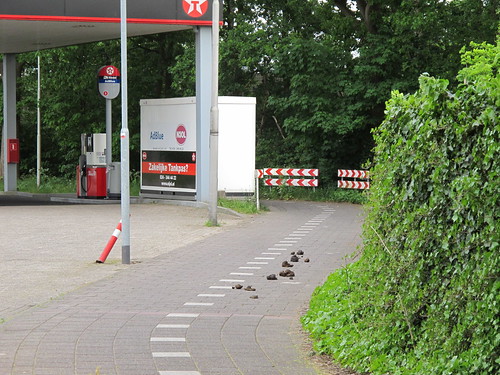
And here's a picture of the classic Dutch "round the back of the garage" arrangement (mustn't obstruct petrol sales now, must we?). Note the sharp blind curve it creates:
Horse critique