Affichage des articles dont le libellé est cycling. Afficher tous les articles

mercredi 13 janvier 2016

Rearranging the urban furniture

from the because-we-need-the-space-for-other-things department
The Bristol Traffic blog, which claims to be about "getting around Bristol", obviously got off on the wrong foot when it was named "bristolcars", so I suppose it was hardly surprising that it failed to publish this comment, beneath a post there regretting "the war on the motorist." They are, of course, under no obligation to publish any remark of mine, though their unwillingness to debate their ideas is duly noted. As ever, I offer it here instead:

"The car is a victim of its own success. Car ownership over the last twenty-five years has continued to increase linearly—see this RAC report for example on: Car ownership in Great Britain According to the RAC, there were 20 million cars on Britain's roads in 1991; by 2007 there were 26 million, with considerable growth in two- and three-car households. Whilst these might at first sight be considered figures in support of your argument for more parking and roads, the problem in town is that space is limited and choices have to be made. If every trip into the centre of town were to be made by car, congestion would rise. Consider the graphic attached to this tweet
which illustrates the amount of road space needed by 48 people using various transport modes: a car, the bus, walking, or a bike. It is clear that cars occupy a vast amount of urban space—and the faster they move, the more they need. This high requirement for space is to the detriment of all other modes, and choices have to be made. Presenting this as a war on the motorist is to fail to understand the impossible demands of the mode for urban space in any streetscape conceived before the 20th century. A streetscape designed for the car looks like Los Angeles, not Bristol, and if you want a city like Bristol to work for everybody, car use has got to be limited in some way."

mercredi 11 novembre 2015

Is cycle infrastructure the new helment?

from the new-Fordist-distractions department


The open access arm of the BMJ has just published the results of an ecological study from Canada, where legislators have created an interesting natural experiment by requiring cyclists to wear helmets in some provinces, but not others. The authors claim surprise that they found no effect in either the overall injury rate or the head injury rate between the provinces, though those of us who have followed what BikeSnobNYC calls the helment (non-)issue are perhaps less surprised. Forced by their negative results to admit helmet legislation has no effect on the substantive issue--reducing danger for cyclists--the authors then proceed to claim that "more cycle infrastructure" is the solution. Although they review the literature, they themselves have no data to add, and as the issue of road design and behaviour is fraught with complication, conflicting interests, and perverse effects, I thought they weren't entitled to a free pass at their sweeping and not altogether well-founded discussion.
As ever when someone is wrong on the internet, I freely composed a comment for the delectation of both the authors and the public. This the BMJ have failed to publish, so, in the best traditions of this blog, it appears here:
These are valuable results and the authors are to be congratulated on their clear presentation.
Given the health and well-being effects of regular cycling, the overall risk of hospitalisation of 622/100 million trips is worthy of wide attention: a chance of ~1 in 160,000 that your trip will end in hospital rather than your intended destination is really rather low, even in the present motor-dominated environment.
However, the recommendation by the authors that more "bicycling infrastructure" is the answer to increasing modal share, thereby augmenting the "safety in numbers" effect is controversial, and is neither justified nor refuted by the evidence presented here. (Cyclists were asked about whether they used their bicycles, not about the routes they took).
My own view is that developed countries already have a highly developed infrastructure that is ideal for cycling called the roads, and that the real problem is negligent driving. Some design features that privilege more direct routes for cyclists and exclude excessive motor traffic (cycle contraflows, modal filters, bicycle boulevards) may be useful, but the real enemies remain excessive speed and drunk driving, and the newer menace of distraction by mobile devices.
Effective measures to reduce these, including stricter policing, driver education, strict civil liability for drivers who collide with cyclists, and proper accident investigation to ensure lessons are learnt, are more important elements for those who would emulate (and surpass) best European practice.
I shall footnote this comment with two more:
1) I am surprised and disappointed at the BMJ's failure to publish the comment in situ, though I suspect this reflects organisational failure to monitor the relevant disqus account rather than any conspiracy to silence me.
2) I suppose it is not surprising that people deluded into a focus on the victim-blaming issue that is cycle helmet promotion and compulsion, will, brought to their senses by the lack of supporting data, switch their allegiance to the unicorn of "cycle infrastructure," instead of the elephant in the room of much-needed motor traffic reduction, better driving-related laws, enforcement thereof, and driver education. These present real challenges of course: but addressing them is what's needed, not demands for a parallel reality of "cycle infrastructure" before cycling can be widely adopted.
And given that such infrastructure is often second-rate while delegitimizing existing cyclists' right to the road, they may be assured that this cyclist at least, will keep calling them out, until his dying breath has been finally drawn.

lundi 5 octobre 2015

Separate development? Or civilised behaviour?


I recently commented on a Guardian article discussing recent deliberate attacks on cyclists in the UK, which uncritically presented the statement:
building segregated bike lanes [is] proven to be the best way to prevent such deaths
 I reproduce it here, for ease of navigation:

***
Reference required? It is rather a controversial matter. It is true that the countries where extensive segregation of cyclists has long been practised (Denmark, the Netherlands) have markedly better safety records than their neighbours. They are no paradise though: there are still 200 cyclist deaths a year in the Netherlands, for example.
But their segregated networks have been obtained at a certain price: the exclusion of cyclists from many parts of the road network (and its superior surfaces and direct travel lines), and slow and complicated junctions.
A Canadian study has showed higher accident rates for cyclists who habitually use footpaths rather than the carriageway. Most collisions happen at junctions. Footpath (and cycle lane) users generally find themselves at a positional disadvantage with respect to the traffic flow just when they most need to be correctly positioned.
A pre-eminent Dutch road safety expert has just published a paper (paywall, sorry) admitting that, in part, his country's superior cycling safety record is because their cyclists ride more slowly. They have to, on often tight cycle paths. Waits at complicated junctions can be long too.
Building cycle paths does reduce the space available for other modes. Such paths are the cowardly choice of the policymaker too timid to confront head-on the reality that the private motor vehicle is a dysfunctional form of urban transport, but nevertheless would, understandably, appreciate less noise, pollution, danger and fewer parking spaces in their town centre.
It has little to do with increased road safety for cyclists though: in fact, life for the cyclist may well be more difficult after they have been implemented, though if this also means fewer motor vehicles in town, this may be nicer for everyone.

***
Here's a video from the UK of the kind of angry entitlement we can expect from motorists once a cycle path, however unsatisfactory, has been built alongside a main road. Talk about realpolitik! (Cyclists in the UK retain their right to ride on the road, and are not obliged to use any cycle path.)

***

Thanks to the authors of these tweets for inspiring this post:

dimanche 30 août 2015

Sorting out saddle problems

from the keep-dancing-on-the-pedals department

This article appeared in the pages of Cycle, the membership magazine of the CTC, almost ten years ago. It doesn't seem to be easily available online there, and it's still useful, so I'm pasting it here for those in need.

 When I confessed to my own saddle problems in the rather public forum of the London Cyclist ten years ago, I certainly discovered one thing: cyclists' bottom problems are a taboo area. There were lots of giggles for a few months after publication, though fortunately the dignity of my profession enabled me rise above them. The article also proffered the anecdote of my own resolution of the problem--a couple of boils on the perineum. Round town I switched from gel to sprung leather, and, on long distance rides, adopted a recumbent. Result: no more problems.
The part of the body that relates to the saddle on a conventional machine is technically termed the perineum. Now, most animals are quadrupeds, and their perineum has less to do, being vertically inclined and acting as the side, rather than the base of the bucket. But humans' upright stance makes the pelvic outlet (as it is known) an insoluble conflict between ease of labour in childbirth and mechanical efficiency when walking on two legs.
The umbrella of muscles suspended from the inside of the pelvis and sacrum collectively is known as the pelvic floor. In men its only defect is the anus, but woman need the space of the birth canal too. Hence, as is widely understood, the adult female's broader girth about the hips, on average, than males.
This fact of nature—the distance between the ischial tuberosities that form the lateral bony boundary of the pelvic outlet—is an important variable in saddle selection. Best bought in person, grasp the demonstration model in the shop, and bring it firmly into alignment with the your ischial tuberosities there and then. Any saddle whose widest part is narrower than this distance runs the risk of inflicting pressure injuries potentially deeper than the skin, as the right and left perineal blood vessels and nerves course forward to the genitalia close to the midline. The anus is also in the midline, but its internal and external sphincters are reasonably robust to saddle trauma.
Out of the shop, saddle correctly fitted, the most obvious saddle injury, instantly painful, is an unexpected blow from an unyielding saddle on an unsprung bike. Unexpected road surfaces--I speak of potholes--can result in a stiff biff where the sun don't shine that is rarely appreciated if unanticipated. Usually the pain settles in a few minutes and the damage is minor, but you certainly don't do it for fun.
More insidious but with the same disastrous potential as a direct hit, is damage caused by lack of blood flow when the pressure of the saddle exceeds the pressure in the blood vessels. The circulation of the skin and pelvic floor muscles is rarely a problem in young adults of either sex, but older riders may start to notice problems, with the first symptom noticeably slower recovery and healing times after longer rides.
The perineal skin can suffer local infection at any time, though it is more likely in summer or warmer climes, when the increased transpiration of moisture from the sweat glands encourages yeasty organisms such as Candida, and mechanical problems such as chafing and maceration of damp skin. If you're prone to a spot of groin rot over the summer months it's probably safe to suggest a strategy of a couple of days of rest off the bike, preferably in a sarong rather than a pair of Y-fronts, and the application of a little clotrimazole cream twice a day, while nature runs its course. Hint: a small folding mirror and a good light can be very helpful when monitoring the progress of your perineum through the course of its cycling career.
There's much more that could be said of course, but do so would require longer than the editor allows: consult your doctor if symptoms persist.
Among cyclists who really know about these matters: the randonneurs and racers of this world, opinion divides on both prevention and treatment of perineal problems, but on one fact all will agree: if you're not dancing in the pedals, you are already finished. As to the merits of padded shorts, the application of pre- and post- ride ungents (such as Vaseline), or specially-shaped saddles (once the basic requirement of physical fit has been satisfied), none agree, as you would expect from the ruggedly individualistic body of cyclists.

samedi 1 août 2015

On the road to cycling hell

This is a translation of an original post I published in French here.

"Be careful what you wish for: it might just come true one day..."

We, as London cycle activists, were always careful not to fall into the pockets of the road engineers and planners, whose responsibility was always for "the possible." We, on the other hand, were struggling with "the impossible"—the end of car culture in town, with its impossible demands for space, its danger and pollution. My vision is still to reclaim the roads for the cyclist, and leave the pedestrian unmolested on the sidewalk. And the Dutch method of "cycle apartheid" has absolutely damn-all to do with promoting cycling; rather it is a dangerous source of oppression.

It's true that planners can do useful things for cyclists: allowing cycle contraflows in one-way systems for motor vehicles (the principle of cycle permeability), and reducing speed limits on roads where necessary. But if each "advance" is accompanied by a degradation, such as, for example, the appearance of "No cycling" signs on roads with cycle paths alongside, one begins to doubt the good faith of the authorities. (This happened in 2012 around Nantes, on the D69 between Nantes and Sucé-sur-Erdre, the D75 between Indre and St. Herblain, and the D107 between Chantenay and Indre).

So I went to a meeting organized by Place au Vélo (Nantes' most significant cycling organisation) to hear a talk by the author and transportation journalist Olivier Razemon yesterday evening, and to criticize their strategy.
I spoke up against this pavement cycling (and separatist infrastructure) during the meeting.

I began my remarks by quoting the aphorism "The road to hell is paved with good intentions", and my opinion that, in the seven years I have lived in Nantes, conditions for cyclists have worsened. And I read an extract from Olivier Razemon's latest book to illustrate the true problem which prevents sharing the road:
"We've all met, at least once, an arrogant, overweight driver, steering wheel in one hand, the tyres of his 4x4 squealing, as he accelerates towards pedestrians, while giving the finger to cyclists."

(They're certainly more common in England, hence my preference for life in France! And the beautiful strict liability law—the loi de Badinter—passed in 1985, gives strength to the cyclist's elbow as well). And I asked Olivier Razemon, and the auditorium in general, if we were ignoring the true problem, that he so expertly describes, whilst scrabbling round in the details of local authority expenditure on street design, with €80 millions budgeted to the year 2020, etc, etc.? Behavioral problems are solved by education and the law, not just road design.

I didn't say at the time, though I might have, that one could justly revise this extract to read "Everyone has already met, at least once, a fit, arrogant cyclist holding the handlebars with one hand, tyres skidding, as he accelerates towards pedestrians, middle finger held aloft to drivers," as a reminder of the new daily experience for crossing pedestrians since Nantes' main north-south cycle route was laid past Commerce. The enemy isn't the transport mode chosen, nor the road design nor its marking: it's the users of wheeled vehicles who lack respect for others.

I think my French was sufficiently fluent to express my ideas, but I don't think my intervention was particularly welcome. The president of Place Au Vélo contradicted my remarks by expressing his affection for the now obligatory cycle path running alongside the D39 D69 to Sucé, and made an ad hominem remark, that, as I was already a convinced cyclist, I was not part of the group of new cyclists they were looking for.

I'm certainly familiar with this line of argument from my time in England, but, to speak frankly, it's bullshit. I have no problem with a choice between a cycle path and the road. But why do you have to make the cycle path compulsory? Because it is inferior.

And there you have it: that's how the rights of cyclists are trammelled whilst claiming to enhance them! It's a manoeuvre of Fordist political genius. The Fordists never forget their fundamental principle: everybody must drive a car. Pedestrians and cyclists alike are an insult to this principle. What could be better then, than to mix them together on the sidewalk in conflict with one another, while leaving the road clear for the real travellers? And if the cyclist has the temerity to continue to use the road when there's a cycle path alongside, give him a good blast of the horn, the rebel! Defenders of cyclists' rights? I don't think so!

mercredi 29 juillet 2015

Rohloff sprocket yields to custom chain whip

from the down-the-vet's department 


So I ordered a new sprocket for the Rohloff, and the special tool to remove the old one, from Bike24. This admirably clear instructional video had given me confidence that replacing the sprocket would be a straightforward job:

The chain whip tool I've long owned is about 30cm long, but when I tried it as recommended in the video, it was clear that it wasn't going to budge the sprocket. I began to develop a serious case of chain whip envy: that man's in the video is simply enormous! Also, I didn't have a 24mm spanner, and an adjustable spanner just isn't as good to use. So, inspired by this video:


I decided to make my own chain whip tool (and score myself a 24mm spanner).

Tracking down the steel flat bar required to make the chain whip tool was the biggest part of the job. A physical copy of Yellow Pages turned out to be more useful than my online searches, which just tended to pull up endless cheesy business directory sites. Anyway, I can highly recommend Blanchard Matériels Industriels (SARL) in Vertou, who were very helpful, even though 45cm of 4 x 25mm mild steel flat bar for €2,65 may not be the biggest order they've ever fulfilled.

Then it was up to Ouest Injection for the correct spanner (the Kraftwerk brand, pleasingly), and home in time for tea! The sprocket had been marinading in WD40 all day, but even with the new longer chain whip it wouldn't budge, despite applying hideous amounts of force. I decided to try heating the sprocket with the Camping Gaz stove. The ensuing WD40 fireball certainly impressed my admiring family audience. Finally, I dipped the sprocket in a bucket of boiling water (holding the wheel horizontally), and at last it yielded. So I have now fitted the new sprocket. You can see the old one, seriously worn, with two missing teeth, lying on the red cloth in this pic:


From top to bottom: Rohloff-hubbed wheel with new 16-tooth sprocket fitted, new 45cm chain whip, old 30cm chain whip, new 24mm key, old adjustable spanner, old sprocket, grease, link extractor.

Oh, and I agree with the commenter below the "make your own chain whip" video that it is crazy to use M3 bolts to secure the short lengths of chain to your flat bar. Using the original chain rivets works perfectly well. According to my vernier, the chain rivets are 3.84mm in diameter, so holes drilled to 4mm diameter in the flat bar were just fine. After a false start placing the holes slightly too far from the edge of the bar to accept the chain links easily, I started over, and hid the bodged holes under the handle tape. You can't use a rivet extractor to resite the rivets (the bar is in the way), but a few careful taps with the ballpeen hammer slid them into place excellently well.

lundi 20 juillet 2015

A brief note on street "closures"

from the opened-for-other-uses department

Using my mother's Mac for a couple of days, and I just rediscovered this comment that I wrote last summer. A Sheffield cyclist had posted a nicely illustrated blogpost of human powered traffic on the streets immediately after the Tour passed there last summer, and was asking for more of it. 

>At least two callers [to a local radiostation phone-in] have suggested that we need to close the roads more often

As you have so vividly illustrated, when we close roads to motor traffic we *open* them to other more convivial uses such as chatting to the neighbours, evanescent art projects, walking, cycling, and even bicycle racing.

This point may seem pedantic, but if, as a cycle campaigner, you fall in with the dismal motor paradigm that does not even admit of a choice in the matter of use of public space, then you are already losing before you begin. Reclaim the roads!

Please note also that there is a large and influential lobby of businesses connected with the provisionment of motor traffic in all its glory--motor vehicle manufacturers, oil multinationals, civil engineering firms etc etc--that would be extremely threatened by the widespread adoption of cycling. As the clamour against road deaths rises, second line measures such as exporting all cyclists to a imagined parallel universe of cycle infrastructure offer false promise of reduction in danger for cyclists. In fact, junctions--the principal source of collision risk for the cyclist--become more complicated, and are arguably, in the absence of modifications in driver behaviour, more dangerous.

The policy of separating cyclists from other traffic also has the highly desirable effect--for the motor lobby--of delegitimising cyclists who ignore inferior infrastructure and continue to ride on the road.


These points may seem to be slightly pedantic, but to paraphrase Richard Stallman, please don't ever embody in your words the assumption that the only traffic is motor traffic, because if you presuppose that reclaiming the roads for other uses is impossible, and that's embedded in your way of speaking, then you'll be working very much against that. And the big picture third paragraph attacking big business is a classic Beezer tactic: just hoping to change one person's mind, just once, at a moment when they might just be ready to. And that is why I write comments, even if they are considered the lowest form of internet literary life.

mardi 30 juin 2015

the true secret of cycling

from the three-at-last department

My guru used to ask "What are the two best things about cycling?" and expect the reply "Pain and suffering." But I, diddling sneakily on a triple, used to wonder what he was on about.

lundi 22 juin 2015

Taking the high road

from the they-don't-have-hills-do-they? department

Everyone who is sincere about encouraging greater use of the bicycle and less use of the private motor vehicle in the urban environment is naturally interested in the experience in the two countries where this tendency is most advanced: the Netherlands and Denmark. But the trend to copy those countries' cycle infrastructure with seemingly minimal consideration about whether this is appropriate for its new locality is highly questionable.

Here in Nantes such separatist infrastructure is proliferating, with, in some cases, bans for cyclists who use the (superior) road alongside, so I do question it. A good example of this regrettable tendency is the two-way cycle track that has been laid parallel to the D75 which runs from the village of Indre, at sea-level on the Loire, to Orvault, ten kilometres north. Orvault bourg is fifty metres above sea-level. To get there, you climb out of the Loire valley, and up onto the lip of the Massif Armorican. This is considered a mountain range by the geologists, though it's a low one.

It's not quite true to say they don't have any hills at all in Holland or Denmark, but basically they don't. In the Netherlands, according to Wikipedia, half of the country is within one metre of elevation above sea level, and another quarter below. Now ask any cyclist: "Do hills make a difference?" Duh!

I rode the D75 last Saturday, and on its rather abrupt climbs and descents reflected just how inappropriate a narrow cycle lane is for such circumstances. Of course the D75 itself is beautifully engineered and smooth, as is normal in France, but the separated cycle lane is narrow, and there is no separate provision for pedestrians who are, admittedly, few. One is obliged to stop (stop line + stop sign) at even the most minor crossings (a hotel entrance, a farm road etc). Entries and exits to it from the major roundabouts are awkwardly angled. I don't have a speedo on the bike, but I'd guess I'd usually go about 45 km/h on the descents. Such a speed is safe enough on a road designed for motor traffic, but the reduced sight lines on the cycle path, and the loss of priority at side roads would make such speeds folly on the cycle path.

On city streets, I guess, I am mostly resigned to playing my part in the charade of motor traffic reduction. If you narrow the carriageway, motorists will drive more slowly, which is safer for everybody, and the so-called "cycle infrastructure" which serves as cover for this reduction in available space for driving is, I suppose, potentially progressive. I've scored a pair of 2-inch wide Schwalbe Kojak tyres for bouncing around the assorted kerbs, tiles, cobbles, and lumps and bumps that Nantes' mayor seems to think we cyclists will enjoy, and I'll certainly be hopping off the cycle path and onto the carriageway as I see fit.

I plan to continue to use the carriageway if I desire brisk progress though, and out in the countryside I'm damned if I'll be chased off France's excellent departmental road network: being able to ride on it is why I moved here.

Happily my fellow lycra-clad compatriots agree: there were quite a few of us roadies still using the road, and quite a few Sunday riders on their mountain bikes on the path (with assorted joggers and dogwalkers). That, it seems to me, is as it should be, though I shall continue to investigate how to reverse the cycling bans on the D75, D39D69 and D107. A clear statement by the mayor that "of course the paths are for the new cyclists," and "naturally we have no desire to impinge upon the traditional rights of existing cyclists," would be useful (and they can take those "No cycling" signs down while they're at it).

In an attempt to better understand the kind of cyclist who thinks separatist infrastructure would be a good idea, I'm following a few exemplars of the type on Twitter, and trying to understand their point of view. One wears a helmetcam as he commutes on busy A-roads around Glasgow (@magnatom); another is a cycling mother who wants to ride on the road with her four year old in Hackney (@bikesandbabies); and a third a Tyneside cycle campaigner who has a German cultural perspective (@katsdekker).

All three share a touching faith in "better cycling infrastructure." I don't disagree with this for major roads (where there are angled slip roads), but if you were to ask me to increase cycling levels as a policy objective, I'd suggest fewer cars, more courteously driven, and better training for cyclists, not some fantasy parallel reality imagined into being by the most anxious cyclists out there. Cycle training is easy for policymakers to pay for. What is not readily legislated for, but what is really required, is greater respect and courtesy from drivers towards cyclists. Strict liability laws would help. So when Kats Dekker suggested on her blog that:
We should be listening to the people who we want to see cycling in the (near) future i.e. the 97%, and make them the subject of our city cycling research – through their eyes can we see the “real” world. Due to circumstances beyond their control, the current cyclist had to turn a blind eye. The current cyclist is desensitised – not by making a conscious decision.
In other words, ignore the 3% of people who actually do cycle when formulating cycle policy, I did feel impelled to respond:
It is true that a perception of danger is the main reason that non-cyclists cite for not cycling. But people say many things. Yer Conservative voter was famously reticent with the pollsters in the run-up to the recent general election for example. But the underlying problem is that it is not normal to cycle. Most people consider themselves to be normal, and would like to drive a car they've seen advertised on the telly.

As for the minority who do cycle turning "a blind eye" to danger: I doubt that this is true, or they wouldn't be cyclists for very long. Existing cyclists have learned to take their place in the traffic. Yes, road conditions can be demanding, and we can all imagine better. Training helps. "See that cycle lane on the left? Ignore it as you approach the junction!" There: just cut your actual risk of dying on your bike by more than 50%.

Note: if a business is trying to grow, it first tries harder to satisfy its existing customers...

Ms. Dekker has not to date posted the comment, so it is published here on the usual premise that it is rejected comments that are the most interesting and valuable. I note the one (anodyne) comment which was posted under that article seems to have disappeared. This lack of desire to discuss her ideas (which resembles Hembrow's) would be sufficient explanation for her being so mistaken in her views.

***
Update 2319h 19/7/19. Following the introduction of separatist-critique tag, the Guardian comment that was here is now has its own page.

mardi 14 avril 2015

Going Dutch? A note of caution for cycle activists


It's almost certainly unwise of me to publish my original compositions in French: the inevitable clunkiness of my style in that language probably frightens off potential clients, and it is unlikely to be the most useful contribution to debate further afield. Nevertheless, such was my burning desire to express myself during this discussion of the effect of the implementation of cycle lanes on traffic more generally (on the CarFree France site) that I broke the rule. And now, no less a personage than Carlton Reid, author of the excellent (and beautifully illustrated) book 'Roads Were Not Built For Cars,' has asked me to translate my comment there. Happy to oblige! Here it is:


 Like Benchaouche Yassin, I live in Nantes, and I agree with him that the arrival of cycle paths does not necessarily mean there has been an improvement in life for the cyclist. There have certainly been good intentions to make policy that encourages cycling here. And the town hall spends a fair amount of cash on the streetscape dedicated to cyclists. Unfortunately, a "gymkhana effect" has been created: an obstacle course of kerbs, bollards, deviations, unnecessary curves, contradictory traffic signals two metres apart etc—which may make the keen mountain biker happy, but hardly seems the right thing for a humble worker who just wants to get to work with a minimum of effort. And what's more, the sensible cyclist who avoids this traffic engineering bullshit by riding on the road alongside now gets given a lesson—by the medium of the car horn—by drivers. It must remain an absolute principle that the cyclist must always retain his or her right to ride on the road. The new lanes are for the new cyclists, the old, the disabled, and children. Of course, it's always good to have a choice. But often, that choice will be direct and quick, on a smooth road.
"Mummy, why is the cycle lane compulsory?"
"Because it's rubbish."

dimanche 13 avril 2014

A consultation with a social librarian

    I came upon GoodReads again this morning, and decided to sign up and give it a goI've been yearning for some medium-light stuff in English to complement my worthy trawl through the French classics, currently La Peste.
    GoodReads is like Facebook for book lovers: 25 million users have shared their literary preferences, and, using the power of the social graph, once you do that too, those magical inklings about what you "didn't know you didn't know" become yours for the taking.
    This technique worked dramatically for me. Told I needed to rate 20 books to start receiving recommendations from the site, I set off, but was being presented with digital screeds of books I'd never heard of, and didn't even care that I hadn't. After scrolling through many pages of this, I finally lighted upon Richard Feynmann's Surely you're joking Mr Feymann?, gave it a five star rating (heartfelt: I even bought it for a nephew last Christmas), and from that moment on, my universe at the site changed completely, and I started to be presented with much more plausible choices of stuff that I might actually want to read. I was reminded that I have yet to tackle much of Dostoyevsky and Kafka for example.
    There was a slight dip when I came to rating my preferences in sport, where, as a simple matter of attentional survival (84kb PDF), I limit my reading strictly to cycling. Amidst a morass of recommendations treating on American-rules "football" (this though the ball is hardly ever kicked), baseball, and basketball, cycling was nowhere to be seen. This time I had to resort the the site's search tool: a search and a click on Tim Krabbé's The Rider sufficed to transform the site once more into friendly territory.
    It's a pretty awesome site, it has to be said. So now the problem is the more familiar "so many books, so little time." But my impression is that the site offers a powerful attentional tool, enabling ready surmise of populist preference, whilst easily forcing it to turn to the interest at hand (say, by specifying philosophical works). For an autodidact this is invaluable. For example, you'd seen references to the 19th century philosopher Schopenhauer, but didn't know where to begin; the GoodReads recommendation looks like a pretty palatable place to start. And unlike at Amazon, the GoodReads reader reviews generally seem non-trivial and sane.

mardi 13 août 2013

Cycle apartheid enthusiast rejects effusion

There's a man called David Hembrow, a resident of the Netherlands, who enthuses about the virtues of the Dutch policy of taking cyclists round the back of every bus stop here. It seems he doesn't really like having his ideas questioned, nor in hosting an honest debate on the issues he raises, which would explain how his views have become so misguided. Ho hum! Here's my comment on his recent post anyway, which M. Hembrow had hoped to moderate out of existence:
These 'cycle paths' round the back of bus stops are exceptionally irritating: I've been negotiating the recently installed series on Brighton's Lewes Road in both directions this summer, and I don't like them one bit. Firstly: why does the cyclist go the long way round? In other words, why should the cyclist negotiate two additional bends and ride some extra metres at each bus stop on each journey? Then, as you mention, there's the usually inferior surface on the 'cycle path' to contend with, the kerbs, the bollards, the additional signage. But now, when I wisely ignore this evidence of local government idiocy, I get hoots and shouts from motorists for being in "their" space. I have no words for this publishable on a family blog such as this one! NO!

Plus: human factors: bus stop users expect traffic in front of them on the carriageway, but not necessarily behind them while waiting, or crossing the 'cycle lane' to the bus stop. So the prudent cyclist using such a 'facility' seeing people in the vicinity of the stop ***inevitably has to slow down.*** Meanwhile public transport users get to occupy a space with traffic whizzing by them on both sides: not good for parents of young children waiting at the bus stop.

Meanwhile, the real users of the road environment, the important people, the people who it's all for: the private motorists, continue on their sweet way, untrammelled by any consideration of users of other modes.

Proponents of these "dif-facilities" are misguided apologists for the triumph of the motor car, in Holland as much as anywhere else. Why else would they be so keen to place obstacles in the way of the cyclist, while removing cyclists' right to follow the ancient desire lines across the land established in antiquity?
If you must insist on modal separation on wider roads, then a 4-metre+ (i.e. generously wide) bus and cycle lane, which leaves pedestrians/public transport users on the pavement, and where the cyclist, enjoying a luxurious and tyre-swept lane whose only other occupants are accountable, professional drivers, has room to overtake stationary buses without changing lanes.
Naturally I keeps a backup copy of every comment I submit, for precisely these occasions: it's the comments that the blogger refuses to publish that are most worthy of heightened attention...

Update 21/4/17: Here's a good example of the kind of annoyance this arrangement generates for pedestrians (and any cyclist accepting the local authority's invitation to ride on the sidewalk) (via road.cc). (A bit sweary, your maiden aunt may appreciate you listening on headphones, if she's within earshot):

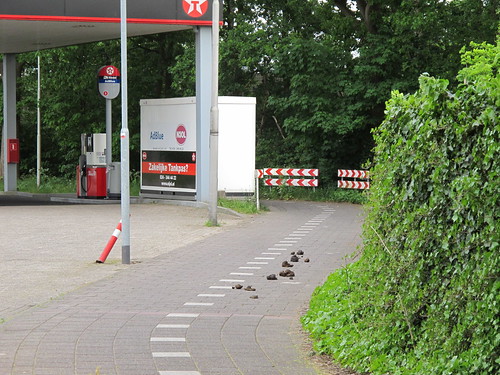
And here's a picture of the classic Dutch "round the back of the garage" arrangement (mustn't obstruct petrol sales now, must we?). Note the sharp blind curve it creates:
Horse critique

mercredi 30 janvier 2013

To Harrow: nostalgia for method

from the just-like-the-good-old-days department
Long ago, in a former life, I would escape the cares of the surgery by going out, then writing about it afterwards. There were certain artistic rules: cycle travel was a given; the concentration and physical effort abolishing any lingering distress I might have had from the poorlies I had been salving at NHS-speed all afternoon.
Naturally I hoped the concert, or art show, or talk, or date, or party would be amusing and enjoyable, or at least interesting. If the event was public, and I liked it, I would often write a review on my then blog. On the principle that if you can't say something nice, best say nothing at all, I gave few, if any, negative reviews. But there was always the bike ride. And sometimes only the bike ride.

I was single then, but a family man now. Just sometimes I look up from the trough of our three squares per day, and think "I was free once, just to ride out for adventure in the night, just for the sensation, and the pleasure, and the boasting of it afterwards to my special secret friend the internet, and now look at me, making the porridge, and telling the boy to put his shoes on half-a-dozen times so we can walk slowly up the damn road to creche." Getting going again is essential for health reasons: my kilometrage has been approaching zero some weeks for too long, and one of my new year's resolutions was definitely to get out on the bike more.
First of course, I needed a bike. Happily I have found a nice one, a 'seventies-era Holdsworth road frame with Campag bits. It's just a tad oversized, but I have oversized male relatives to pass it to when I'm done with it in a couple of months, and with rack, mudguards, lock and lights fitted it's a handy winter machine.
And my second resolution was to scorn the purist and jump the train if the timetable demanded it. And so all the parts were in place for adventure. I first encountered Philip Lee at show on the South Bank with Siobhan, eons ago, before the move to France. He was doing his thing—pouring potter's slip from a large tray on the gallery floor over his nude body, slowly, over an hour. It was a big group show—a St. Martin's degree show?—and hundreds of people were coming and going as he slowly transformed himself into a clay-covered gargoyle. But I'd happened to arrive just as he was starting the show, and so I stayed throughout, and complimented him on the work after, and he's been sending me emails to his private views ever since. My move to France has meant it has always been necessary to send my regrets, but I've always remembered his work. It was cool.
And here was the day, and there was my bike. And there was the sunshine over Sussex's pleasant valley. I sent off the job to Thibaut. Alexandra cancelled our lunch. Martin was safely in the crêche. Time to go. First, I had to fit my cleats on my new shoes. A short run to the shops had taught me that I cannot ever go back to toeclips. It's bad enough getting used to riding on the left again, and the general mania, ignorance and carelessness of Ingerland's motorists, and lots of unfamiliar road territory, without having to look down to see if your foot's trapped the toestrap. And I've been needing a new pair of cycling shoes for a while now. I pulled off the tab on the sole of the show, and screwed on the cleats. Whenever I've done this before, I've always been making an exact copy of the position of the cleat on the old shoes, so this is the first time I've had to do it from scratch for more than... fifteen years, I reckon. Blimey.
The sun is still shining as I pack my bag. I wear my summer jacket, but I pack the winter one. I have a few tools and the pump, some Golden Syrup cake for bonk rations, a bottle of water, my notebook and pen, a camera, maps, all in a lovely new Ortlieb. Riches.
I eat a partially premasticated egg sandwich. I drink some water. Now it is time to go. The plan is to ride as slowly as possible to Hayward's Heath, then skip on the train to London, and find my way to Harrow aka bleedin' Wales, for its extremely northerly and westerly relation to more civilised parts of town, for the cyclist at any rate.
I unlock the bike. It looks OK. I think about for a moment, then I put the bag on the right side so its reflector will be on the offside for following traffic, and jut out for a slight illusion of width, and get going. There is a little downhill immediately. As I turn the pedals for the first time at the bottom of the slope, I realise I am going to have to stop and adjust the 3mm Allen bolt on the bottom clip of the Ortlieb to stop it brushing my heel each turn of the pedals.
This I do. In the sun. It is very pleasant and effortless. Afterwards the pannier attaches very firmly. I decide to tweak the stem bolt while I'm at it. It wouldn't move the other day, but I left a bit of lube sinking in, and Lo! It turns. I drop the bars a couple of cm and straighten them, and things are much better.
In another couple of hundred metres I meet Stanley heading north on his bike, so we stop for a little chat. We need to book him a week in advance apparently, such is his oppressive work schedule. He heads off to his society meeting, and I decide to raise the saddle another 12mm. This rocks. Very comfy now, and legs turning effortlessly, there is now no excuse for not fulfilling the plan.
Hemmed in as the campus is by the delightful A27 (Noisy all day! And all night!), there are little cycle crevices of escape, and one of these led me to the foot of the road to Ditchling, and up and over I went.
It is very steep, and I am carrying a few kilos that by rights should be a pig's, and it was a new bike, with unfamiliar gear ratios, but there was that nice wee ring on the triple that I specified, and there was me, twiddling up a valley wall that felt like 45°, but perhaps was about 1 in 10.
I quickly remembered why I emigrated. English drivers are weird round cyclists. If the road is clear the other direction, they'll overtake you properly, going wide. If it's not, they just barge past with inches to spare, causing both the cyclist (me) and the driver of the vehicle coming in the opposite direction intense alarm. The longer the tail of traffic behind the leading motorist, the hairier and more ignorant (in the sense of ignore-ant) each successive overtaking manoeuvre gets. They just don't know how to drive properly, because if they did, they would slow down, and wait for the good moment to overtake, like they do in France.
There was a Stop/Go at the top, and a crew were lopping overhanging branches with chainsaws on sticks. This was good to see, as were the sweeping lines of seedling green curving off through the chalky soil to approach infinity. I did not pause for a moment at the top, but plunged down, taking the lane to prevent my pursuers from cutting me up, and braking rather cautiously for the curves, which were unfamiliar, and potentially still gritwashed by melting snow products from last week's extravaganza.
Then it is flat, and the houses cost a million and are sold by Rudyard Kiplard and other Country Life estates agents, and the post office is in a half-timbered building that hasn't just retained its original features: it is the original feature.
I saw one too many country casuals striding out to Range Rover on gravelled drive in battered Barbour, and I know one should not yield to visual prejudices, but, let's face it, almost certainly tossers.
Hayward's Heath came all too soon. The very helpful ticket agent proffered me a route sheet for the train without being asked, and I accepted all her advice with a slightly cheeky "I am in your hands madam. And a very pleasant sensation it is indeed." This made her laugh, and her younger colleague blush, so that was a result.
My problems set in at Olympia, where the connecting train from Clapham filled up so alarmingly with suited corporate warriors, none of whom, I inferred, particularly wanted my oily chain and muddy mudguards pressed against the lower half of their immaculately clad bodies.
So I got off. Well, I was north of the river: how much further could it be? My knowledge of west London is sketchy indeed, and once I get beyond Harlesden it is non-existant. I managed to find my way from Olympia to Shepherd's Bush, by creating a parallel route to the rail line I had just left and spotting Goldfinger's Trellick Tower off in the distance. Through the straitened squares of North Kensington, where every basement is a luxury kitchen, even if the view from the oak refectory table is to the shoes of passers-by about three metres away. I even recognised my crossing point at the Regent's Canal! Now I was getting somewhere. But also it was 1730h and every motorist in London had had the same idea as I: of heading north and west and out and away from the grimy city where pale, slack faces look ill and tired, and cocky city boys strut and fret, and every shop window offers international phone cards, crap sweets, and maybe some dusty fruit, up the hill through Freyant Country Park, where the queues of traffic are so long and so tedious (if you are not overtaking them all on a bike) that the drivers drift and weave and you think "Are they drunk?" and sure enough they're texting on their mobile phones. I made a few choice remarks as I passed (Dude! You're driving. Pay attention!)
I tried quite hard to buy an A-Z. But newsagents and garages yielded nothing but helpful directions, and even the offer of a lift, which I declined. They are car oriented in these parts, and now in the dark I was contending with two lanes of impatient motorists in each direction, who showed little mercy or consideration for the cyclist, and I thought "You're well off your manor my son," and cursed the unforgiving, harsh road environment for cyclists, and congratulated myself on my prolonged absence from this scene.
At last a kind gentlemen outside a tattoo parlour said, "University of Westminster? Second right and walk through the tube station." And he was right. I found some bike racks and walked up to the door of the gallery, to be greeted by a lady in piebald pinks whose poems, handwritten on coloured paper, were attached on a rack down the front of her suit. This is the clothes sense of frontal lobe disinhibition, but she welcomed me nicely, and I told her I had come to see the show, which pleased her, and I passed security and into a bright light hall with a side gallery, and serious, clever, animated people, and best of all (for there were more than 30k in my legs, and very little lunch in my stomach)... A BANQUET. My kind of show, definitely.
I weary (~0200h, 31/01/13). Coming up in Part II--paintings, sculpture, a show. Images thereof, and annotations.
Update (0122h: 01/02/13) Part II is on flickr, here The brevity of the images' comment boxes is in many ways a relief. (Getting late again, remember Balzac, whose death at 51 was surely not unconnected with his work habits).


dimanche 5 juin 2011

A star is dead

He was a bit of a star was Barry Mason. A delightfully enthusiastic presence. A tireless activist for the cause of cycling. And a very nice man. So it's sad news that he's dead, aged only 60. Still, what a great way to go: swimming off a beach on a cycling trip to northern Spain—in June. Somewhat reminiscent of the death of the great Roy Porter, who died, at a similar age, cycling home from his allotment with a bunch of fresh daffodils in the basket.
Bazza (as I once rather disrespectfully called him, to his obvious horror) will be fondly remembered by a great many people as one of the good guys. There is no higher accolade in the Beezer thesaurus.

lundi 24 mai 2010

on boredom while cycling


That's twice I've been told now, in the last year, by people I care about—my nephew and my lovely—that they can be bored when they are riding a bike. This has happened to me in the past, but very rarely—I hesitate to say never—does now.

I've made a start on trying to explain why that might be: