dimanche 2 mars 2014

Shocking resort to science to resolve question of English language usage

Almost two years ago, David Crystal posted a short article on his blog musing about when to use "for instance" and when to use "for example." Such pedantry is perhaps not the most thrilling topic, but I guess métier oblige, and Mme Beezer and I count ourselves among his fans: she even buys his books.

As Crystal was requesting the intuitions of his readers, and as anyone had yet to post, I thought it a reasonable opportunity for increasing my notoriety, and quickly drafted a few remarks. These stated my intuition that "for instance" was perhaps more likely to be used in spoken English, than "for example," and showed that "for example" was more common, citing evidence from the Google Books corpus. I also remarked that my hunch about spoken vs written usage would be testable, given access to the right corpus. Happily I managed to express all this, and still get the first post, which I'm sure are more read than others 'below the line'.

Even more happily, I'm now five weeks into the most excellent Future Learn MOOC on corpus linguistics, which has given me access to the British National Corpus, and some good teaching about to how to use it. Anyway, as we all now know on the course, the BNC comprises corpora of both transcribed speech and written texts, enabling me to test some of the intuitions I offered Crystal two years ago against hard data. Here's a table showing the relative frequencies of both terms in the spoken and written sections of the BNC:
SpokenWrittenWritten/Spoken
For instance51.4976.61.49
For example106.25257.42.42
(freq/10^6 words)(freq/10^6 words)(ratio)
Data: British National Corpus hosted at http://bncweb.lancs.ac.uk/
As you can see, the outnumbering of "for instance" by "for example" witnessed in the Google books corpus is replicated. I'm no statistician, but it does look as though "for instance" is relatively more favoured in speech than in writing, when compared with "for example."
As some of Crystal's other commentators (Lucy, Rick Sprague) remarked two years ago, fr'instance does slip more felicitously off the tongue, or, if you like that kinda thing, "is preferred for phonotactic reasons."

lundi 24 février 2014

Don't want a new airport? Tear gas for you!

Obviously I went to the demonstration against the proposed construction of an airport at Notre-Dame-des-Landes (#NDDL). My pics are here. I have captioned them all, though the default Flickr landing page gives no clue of this: click through to the view which does present the captions alongside if you'd like to read them.
Happily, the excellent Hervé Kempf, formerly of Le Monde, has written a very fair report of events on the day, which I entirely endorse, saving me a job here.
As far as I know M. Kempf doesn't actually live in Nantes, so I'll just add that I share the view of some quoted in his article that the tactics of the authorities towards the demonstration on Saturday were:
a) unprecedented: every Nantes demo I have seen has gone up the cours de 50 Ôtages, so to place a great barrier and a water cannon to prevent this is an obvious provocation: it's like banning a big Edinburgh march from Princes Street, or Londoners from Trafalgar Square; and
b) entirely counterproductive to the maintenance of public order.  As I have observed in the comments to the YouTube video embedded below, which shows some time lapse footage of this point of confrontation between riot police and demonstrators, the authorities evidently wished to provoke this violence. Of course the threat of violence is an effective way of reducing the size of demonstrations (for example, though, like me, squarely against the proposed airport, Mme. Beezer et fils were understandably reluctant to turn out for their corporal punishment by the state, a reluctance I endorsed). It might be an effective tactic on the part of the authorities, but it's a grave stain on their purported democratic credentials.

This debacle has reportedly resulted in at least six injured police officers, and a young demonstrator losing an eye. I myself don't appreciate being teargassed as I peacefully express my political views on a matter of legitimate public concern.

They're backing a loser though: I really don't know anyone here who's in favour of the proposed airport, and what poll data I've seen suggests that this is because very few people are. The so-called pro-airport demo a few months back was pitifully small, and all this "silent majority" stuff they're coming out with is frankly, nonsense. (That was a ruder word in the first draft). And don't forget that the natural pro-airport constituency (like, I regret to say, frequent flyer Mme Beezer) are pretty happy with the existing airport, which is actually part of Nantes, and easy to get to, like, if you want to go to and from Nantes (duh!), and would be even better (e.g. requisite 1.2k of tramway connected +/or direct rail) if it hadn't had the ridiculous 40 year planning blight hanging over the 30k-away-and-no-public-transport airport on offer following any "transfer" to NDDL.

The insane persistence of the authorities in the pursuit of this project, which if it ever made sense when first mooted in 1967, is, in 2014, quite clearly SHEER BLOODY FOLLY.  The chaos in the centre of Nantes this Saturday was the result of the ineptly provocative tactics on the part of the authorities and the man responsible, Prefet Christian de Lavernée, should resign. Must we really wait for the political figures who have most invested in the project to be sacked, retire or die before the plan is cancelled? Or will they see reason? I trust that comparisons with recent events in the Ukraine are inappropriate...
Update 14:45h Tue 25 Feb 2014: According to today's local papers (Presse Ocean, Ouest France) more than 100 people were injured, of whom ten police officers and twenty demonstrators required hospital admission. The most severely injured person was a 29 year old man who reportedly lost his left eye to a flashball fired by a police officer. The cost of the clean-up is estimated at €1million euros.
And while we're here, a wee note on the media coverage:
The establishment media seem to have dutifully devoted multipage spreads to the violence and damage to property, happily enabling them to avoid the rather awkward facts of the debate proper:
a) reputable surveys show that the majority is against the airport;
b) the enormous €266million subsidy the project requires;
c) the authorities' lawbreaking with respect to legislation on water, the environment, and endangered species;
d) the effect of aviation emissions on climate change targets, and future kerosene price trends.
Ho hum!
Update Mon 14 Apr 2014: The number of demonstrators losing an eye to a headshot from a flashball has now risen to three. As a James Bond villain once observed, "Once is happenstance, twice is coincidence, but three times is enemy action." In other words, one or two such injuries might be explained by bad luck or negligence, but the third is strongly suggestive of malice. Charges have, rightly, been filed. Ce n'est pas fini, as the French say.

vendredi 31 janvier 2014

HuffPo atheists: "Let (some) freedoms ring"

from the freedom-from-illegal-invasions-is-also-a-human-right department
   The Huffington Post irritates in so many ways—from its browser-jamming javascripts, to its hideous advertising, to its forcing its .fr content upon me, even if I specify a .com URL. Still, HuffPo's been hard to avoid on general internet patrol recently, after my impulsive decision to follow one of its Middle East specialists for a while.
   Thus it was that I came upon this conversation between two north American atheists, of Pakistani and Iraqi origin. Now I feel a certain extra responsibility and compassion for the people of Iraq—it was, after all, partly my taxes that paid for their country to be royally fucked over in recent years. Getting one's head round the situation there obliges a wider concern with the Middle East more generally.  But this is the kind of thing that I'd usually read quickly and move on: sadly, 'middle eastern atheists cop their share of oppression, and there's plenty to go around,' is not such a surprising message. But there was something about their mutual consensus that people in the West "take their rights for granted" while supporting, in the same paragraph, the illegal actions of Western governments towards their former countries, that I thought was maybe worth puncturing.
   Comments were apparently open at the foot of the article, but my attempt to post a comment (using my Twitter account) failed, I know I'll get spammed to death if I give them my email, and I don't particularly think my friends will be interested in a HuffPo Facebook app spewing all over their timelines. So I gave up. Someone remains wrong on the internet! But, following the strict artistic rule that it is the comments that are difficult to post in situ that are most worth publishing, here it is:
It is certainly a good point that many in the West take their rights for granted because the political struggle for them took place before they were born; but the invasion of Iraq was a great crime precisely because, in doing so, the US and the UK were thumbing their noses at the authority of the UN's Security Council, and by extension the post-WWII settlement. In his hurry to damn the American left, and roam the world removing dictators he doesn't like, the M. Al-Mutar seems to have forgotten this.

vendredi 15 novembre 2013

The job ain't finished till the paperwork's done?

It's been a fairly quiet week in the cabinet, and all my birthday books have arrived including the latest (2nd) edition of the European Science Editors' Handbook. It's a unique compendium of scientific and publishing information, so I've been doing a little reading in between some admin tasks, and pondering its various chapters on taxonomy, a subject that I haven't considered per se for, ooh, nigh on thirty years. So, when Ross Mounce's tweet bounced into my feed earlier in the week, my mind was particularly prepared to dive into what may be the last storm before the final triumph of the web.
Ross was drawing attention to a 94-page article in ZooTaxa from a group of eminent taxonomists whose point of view basically seems to be that if it's not published on paper, then it doesn't exist, at least for the purposes of establishing precedence. Convention required, until the rules were amended in 2012, that at least five paper copies of any article be lodged in five separate reference libraries. Now, on first reflection this position seems somewhat dinosaur-ish, but Dubois et al's meticulously documented critique of the slippery nature of online publishing should give web triumphalists pause for thought.

As I understand them, Bubois et al's view is that an insistence on a paper publication forces all concerned to fix upon a canonical version of an article that exists and is publicly available for sale or by request at a certain date. Precedence is sacrèd in taxonomy because the winner gets to name the newly discovered lifeform, immortalizing a hero along the way, and the discoverer is then cited as the 'authority' responsible thereafter. With the prize of immortal memory at stake--not quite as good as having an SI unit named for you, but close--a legalistic rule book has developed over the years to ensure justice is done.

Dubois et al. are particularly scathing of electronic publishing practices which change articles without updating the publication date and reference information. Taking the long view—many 18th century works of taxonomy are apparently still in current usage—they criticise the electronic publishing community in general and BioMedCentral in particular, for playing fast and loose with traditions and systems that have accreted over literally centuries. As the linkrot rate, even in scholarly publishing, reportedly approaches 40% about five years after publication, the traditionalists certainly have a point, and everyone concerned with scientific communication would benefit from reflecting on Dubois et al's justified criticisms, and considering what may be done to address them.

Paradoxically of course open access is part of the solution—lots of copies keeps stuff safe, and all that, but there is still, in my view, a need to force all concerned into producing a canonical version of an article, and the moment when a file is fixed for the presses to roll would be a pretty good time for that. Then there needs to be some sort of digital service that provides assurances that we're dealing with files that have integrity. All the technical problems for this are already solved in the software world, but it will be a while yet before the necessary technical changes have fully permeated into non-technical scholarly areas. So I'm sure there'll be some space for boutique paper publishers for some time to come.

Update 1830h: I had to rush out to pick up the boy from school moments after completing the first draft of this blog at 1630h, so it seems a fitting homage to Prof Dubois to tweak it a bit now I've got a moment, but leave all the publishing metadata essentially unchanged. (!)
Update 17/11/2013 1310h: 1) My own response to Ross' tl;dr plea, after the briefest of flicks through Dubois et al's PDF, was admirably on target, though I say it myself: 2) Dubois et al's article really should have been better edited. A document of 94 pages begins to demand either a table of contents, an index, or preferably both, for sparing yourself this effort wastes everybody else's time. The unwieldy nature of the article undoubtèdly undermines its rhetorical effectiveness. ("Sorry for this long article, I didn't have time to write you a short one."--> But then, if you're ranting for the canon of the centuries, perhaps this is not an excuse you can honourably pull. 3) Also, if it was proofread by a native English speaker, s/he missed a few Franglicisms, deep down the page, none grave, but still...

jeudi 22 août 2013

Bayesian limits to screening populations for rarities e.g. "being a terrorist"

Silicon valley software engineer Ben Adida (36) certainly doesn't hesitate to grovel before his president in his recent blog post concerning the recent revelations of US state surveillance of the internet: ["...I’m no stubborn idealist... I know you cannot steer a ship as big as the United States as quickly as some would like. I know tough compromises are the inevitable path to progress... The responsibility you feel, the level of detail you understand, must make prior principles sometimes feel quaint. I cannot imagine what it’s like to be in your shoes..."] Yuk! The ship of state, with its concomitant all-powerful captain fully implied. Yuk, and yuk again, puke! But M. Adida does make a good point about the unintuitive statistical operation of true and false positives in population screening programmes, be they medical or criminological. The explanation he offers on his blog is correct, but lacks detail. More seriously, for anyone who'd like to know more, a couple of keywords needed to construct a quality search are missing. These were "false positive" AND "Bayes", so I decided to post a wee comment mentioning that, and a link to the best explanation I found. Perhaps M. Adida has just had enough of blog spam, but he seems to accept comments only very selectively on his blog: and mine was not one. Ho hum! Anyway, he's quite right to point out that even a good (say 99% accurate) test for a rare condition (e.g. being a terrorist) applied to a large, mostly innocent population will generate WAY MORE false positives than true positives. This has two bad effects: 1) innocent people are wrongly suspected and subjected to further unjustified intrusion and harassment; and 2) law enforcement time is wasted. You might suppose that intelligences sufficient to build data centres capable of archiving the whole internet would also be fully conversant with Bayes' Theorem. But with no meaningful oversight, how can we be sure? Idiocy is common; and mission creep happens all the time. Just like the Hackney wide boys who can't resist trying out their guns over the back hedge once they've bought them, the temptation to mine all that data must be well-nigh irresistible--but wrong.

mardi 13 août 2013

Cycle apartheid enthusiast rejects effusion

There's a man called David Hembrow, a resident of the Netherlands, who enthuses about the virtues of the Dutch policy of taking cyclists round the back of every bus stop here. It seems he doesn't really like having his ideas questioned, nor in hosting an honest debate on the issues he raises, which would explain how his views have become so misguided. Ho hum! Here's my comment on his recent post anyway, which M. Hembrow had hoped to moderate out of existence:
These 'cycle paths' round the back of bus stops are exceptionally irritating: I've been negotiating the recently installed series on Brighton's Lewes Road in both directions this summer, and I don't like them one bit. Firstly: why does the cyclist go the long way round? In other words, why should the cyclist negotiate two additional bends and ride some extra metres at each bus stop on each journey? Then, as you mention, there's the usually inferior surface on the 'cycle path' to contend with, the kerbs, the bollards, the additional signage. But now, when I wisely ignore this evidence of local government idiocy, I get hoots and shouts from motorists for being in "their" space. I have no words for this publishable on a family blog such as this one! NO!

Plus: human factors: bus stop users expect traffic in front of them on the carriageway, but not necessarily behind them while waiting, or crossing the 'cycle lane' to the bus stop. So the prudent cyclist using such a 'facility' seeing people in the vicinity of the stop ***inevitably has to slow down.*** Meanwhile public transport users get to occupy a space with traffic whizzing by them on both sides: not good for parents of young children waiting at the bus stop.

Meanwhile, the real users of the road environment, the important people, the people who it's all for: the private motorists, continue on their sweet way, untrammelled by any consideration of users of other modes.

Proponents of these "dif-facilities" are misguided apologists for the triumph of the motor car, in Holland as much as anywhere else. Why else would they be so keen to place obstacles in the way of the cyclist, while removing cyclists' right to follow the ancient desire lines across the land established in antiquity?
If you must insist on modal separation on wider roads, then a 4-metre+ (i.e. generously wide) bus and cycle lane, which leaves pedestrians/public transport users on the pavement, and where the cyclist, enjoying a luxurious and tyre-swept lane whose only other occupants are accountable, professional drivers, has room to overtake stationary buses without changing lanes.
Naturally I keeps a backup copy of every comment I submit, for precisely these occasions: it's the comments that the blogger refuses to publish that are most worthy of heightened attention...

Update 21/4/17: Here's a good example of the kind of annoyance this arrangement generates for pedestrians (and any cyclist accepting the local authority's invitation to ride on the sidewalk) (via road.cc). (A bit sweary, your maiden aunt may appreciate you listening on headphones, if she's within earshot):

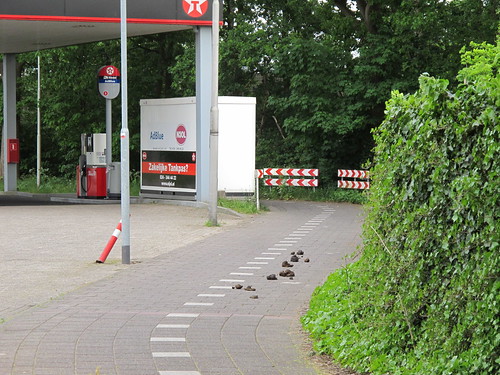
And here's a picture of the classic Dutch "round the back of the garage" arrangement (mustn't obstruct petrol sales now, must we?). Note the sharp blind curve it creates:
Horse critique

mercredi 26 juin 2013

Why I write comments (and where you can find them)

When I decided, in 2009, to re-establish an online presence after a couple of years off, I made a couple of decisions whose effects persist to this day. Firstly, I decided to play with being anonymous, and Julius Beezer was the character I invented to represent me on the internet.§ As does happen, this representation has now spilled over into real life: my modest translation and editing business is entitled "Cabinet Beezer," and I write this from my cabinet, a real place, for which I pay rent.
To pay the rent I accept translation and editing tasks that fit with my interests, but much of the time I find myself on what I call "general internet patrol": engaging with my longstanding interest in the medium of internet communication generally, and specifically free software and open access scholarly publishing. Although my degree was in medicine, and I practised for many years as a GP in east London, my translation activity has pulled my centre of interest into the humanities: languages, belles lettres, philosophy, and history. I consider myself fortunate that my interest in these subjects has developed in the age of the internet.

Outputs

Although I maintain several blogs in the spirit that rights that are not exercised are lost, and do indeed use them as a convenient place to publish a bit of text when the moment strikes,* I no longer primarily consider myself as a "blogger"; indeed, I find the term in contradiction with my longing for the overturn of Gramsci's observation that "all men are intellectuals but not all men have the public function of intellectuals." In other words, everyone should blog, when they feel like it, and hopefully that'll be helpful.
But what I really want to do is change peoples' minds. Whatever I write, I write primarily for the satisfaction of being able to reread it and say "Yep, that guy's nailed it. At least there's someone on the planet I totally agree with!" It struck me that one of the conventions of blogging—the replies function—is undervalued, and I decided to explore it as a participant-observer.  I've enjoyed reading reading blog comments since the early days of Slashdot, and the BMJ's rapid responses, back in the day when it was unpaywalled: there's a new kind of truth there that wasn't possible before. And new problems of course.
I found, when I looked recently, for example, that I have left 72k words at the Guardian's 'Comment is Free' site over the last four years.† But the Guardian is unsatisfying for several reasons, and now that I have a well-populated RSS stream, I prefer the roads less travelled away from the mainstream.
I collate this activity as a set of public bookmarks along the way, which enables a chronological listing of the comments as I left with them, using two tags dccomments and jbcomments. I also maintain a list of tagged bookmarks relating to the activity of commenting itself.
All this was just by way of diving in. But my theoretical knowledge is growing, and maybe one day I'll write something solid about commenting, and attention, and democracy, and the internet, but in the meantime, I'll just have to leave it to your imaginations and this lousy blogpost.
---
[update: 27/8/14] *Particularly, it must be noted, when a comment composed for another online venue is rejected. Examples: twitterblocking, cycle apartheid, France24 rejection, screening for terrorists, HuffPo atheists.]
[update: 30/11/15] §This conceit was formally abandoned on 28/06/14
[update: 22/01/16] †Fixed busted link to juliuzbeezer public profile at The Guardian's site. That word count is out of date now, though I effuse there much less frequently than I once did.