mardi 13 août 2013

Cycle apartheid enthusiast rejects effusion

There's a man called David Hembrow, a resident of the Netherlands, who enthuses about the virtues of the Dutch policy of taking cyclists round the back of every bus stop here. It seems he doesn't really like having his ideas questioned, nor in hosting an honest debate on the issues he raises, which would explain how his views have become so misguided. Ho hum! Here's my comment on his recent post anyway, which M. Hembrow had hoped to moderate out of existence:
These 'cycle paths' round the back of bus stops are exceptionally irritating: I've been negotiating the recently installed series on Brighton's Lewes Road in both directions this summer, and I don't like them one bit. Firstly: why does the cyclist go the long way round? In other words, why should the cyclist negotiate two additional bends and ride some extra metres at each bus stop on each journey? Then, as you mention, there's the usually inferior surface on the 'cycle path' to contend with, the kerbs, the bollards, the additional signage. But now, when I wisely ignore this evidence of local government idiocy, I get hoots and shouts from motorists for being in "their" space. I have no words for this publishable on a family blog such as this one! NO!

Plus: human factors: bus stop users expect traffic in front of them on the carriageway, but not necessarily behind them while waiting, or crossing the 'cycle lane' to the bus stop. So the prudent cyclist using such a 'facility' seeing people in the vicinity of the stop ***inevitably has to slow down.*** Meanwhile public transport users get to occupy a space with traffic whizzing by them on both sides: not good for parents of young children waiting at the bus stop.

Meanwhile, the real users of the road environment, the important people, the people who it's all for: the private motorists, continue on their sweet way, untrammelled by any consideration of users of other modes.

Proponents of these "dif-facilities" are misguided apologists for the triumph of the motor car, in Holland as much as anywhere else. Why else would they be so keen to place obstacles in the way of the cyclist, while removing cyclists' right to follow the ancient desire lines across the land established in antiquity?
If you must insist on modal separation on wider roads, then a 4-metre+ (i.e. generously wide) bus and cycle lane, which leaves pedestrians/public transport users on the pavement, and where the cyclist, enjoying a luxurious and tyre-swept lane whose only other occupants are accountable, professional drivers, has room to overtake stationary buses without changing lanes.
Naturally I keeps a backup copy of every comment I submit, for precisely these occasions: it's the comments that the blogger refuses to publish that are most worthy of heightened attention...

Update 21/4/17: Here's a good example of the kind of annoyance this arrangement generates for pedestrians (and any cyclist accepting the local authority's invitation to ride on the sidewalk) (via road.cc). (A bit sweary, your maiden aunt may appreciate you listening on headphones, if she's within earshot):

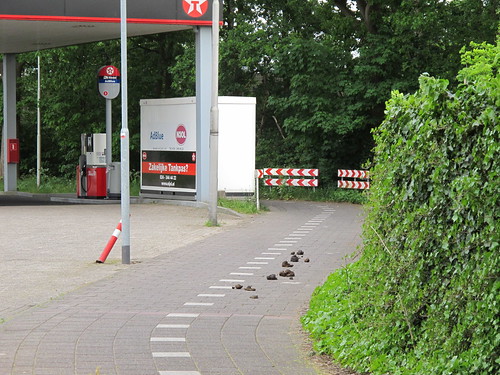
And here's a picture of the classic Dutch "round the back of the garage" arrangement (mustn't obstruct petrol sales now, must we?). Note the sharp blind curve it creates:
Horse critique

mercredi 26 juin 2013

Why I write comments (and where you can find them)

When I decided, in 2009, to re-establish an online presence after a couple of years off, I made a couple of decisions whose effects persist to this day. Firstly, I decided to play with being anonymous, and Julius Beezer was the character I invented to represent me on the internet.§ As does happen, this representation has now spilled over into real life: my modest translation and editing business is entitled "Cabinet Beezer," and I write this from my cabinet, a real place, for which I pay rent.
To pay the rent I accept translation and editing tasks that fit with my interests, but much of the time I find myself on what I call "general internet patrol": engaging with my longstanding interest in the medium of internet communication generally, and specifically free software and open access scholarly publishing. Although my degree was in medicine, and I practised for many years as a GP in east London, my translation activity has pulled my centre of interest into the humanities: languages, belles lettres, philosophy, and history. I consider myself fortunate that my interest in these subjects has developed in the age of the internet.

Outputs

Although I maintain several blogs in the spirit that rights that are not exercised are lost, and do indeed use them as a convenient place to publish a bit of text when the moment strikes,* I no longer primarily consider myself as a "blogger"; indeed, I find the term in contradiction with my longing for the overturn of Gramsci's observation that "all men are intellectuals but not all men have the public function of intellectuals." In other words, everyone should blog, when they feel like it, and hopefully that'll be helpful.
But what I really want to do is change peoples' minds. Whatever I write, I write primarily for the satisfaction of being able to reread it and say "Yep, that guy's nailed it. At least there's someone on the planet I totally agree with!" It struck me that one of the conventions of blogging—the replies function—is undervalued, and I decided to explore it as a participant-observer.  I've enjoyed reading reading blog comments since the early days of Slashdot, and the BMJ's rapid responses, back in the day when it was unpaywalled: there's a new kind of truth there that wasn't possible before. And new problems of course.
I found, when I looked recently, for example, that I have left 72k words at the Guardian's 'Comment is Free' site over the last four years.† But the Guardian is unsatisfying for several reasons, and now that I have a well-populated RSS stream, I prefer the roads less travelled away from the mainstream.
I collate this activity as a set of public bookmarks along the way, which enables a chronological listing of the comments as I left with them, using two tags dccomments and jbcomments. I also maintain a list of tagged bookmarks relating to the activity of commenting itself.
All this was just by way of diving in. But my theoretical knowledge is growing, and maybe one day I'll write something solid about commenting, and attention, and democracy, and the internet, but in the meantime, I'll just have to leave it to your imaginations and this lousy blogpost.
---
[update: 27/8/14] *Particularly, it must be noted, when a comment composed for another online venue is rejected. Examples: twitterblocking, cycle apartheid, France24 rejection, screening for terrorists, HuffPo atheists.]
[update: 30/11/15] §This conceit was formally abandoned on 28/06/14
[update: 22/01/16] †Fixed busted link to juliuzbeezer public profile at The Guardian's site. That word count is out of date now, though I effuse there much less frequently than I once did.

mardi 19 mars 2013

Outrage to freedom of expression in a British university

Life as supportive spouse and father takes up most of my time on campus, so I haven't really paid too much attention to the Sussex University occupation protesting the privatisation of campus services, now in its fifth week. I broadly support their aims though, and the other day a gap in my schedule between talk and pre-school pickup coincided with a loudhailer call from on-high to come up and look at their art show. How could I resist?
The upshot of the conversations I had at the show was that news of the occupation of the ZAD in Nantes would be of interest to the Sussex occupiers, so we agreed I'd put together a talk about this for the following Tuesday.
That Tuesday has now arrived, but my talk has not! I spent the afternoon scrabbling images off the net with complete abandon for copyright (so I won't post the slides), and toddled up to the 3rd floor conference room to check in with the collective about 18h, check the projection facilities and so on. This was no problem, but when I returned just before the invited hour of 20h to actually give my talk, two very large black-clad men with sinister armbands physically barred my entry to the room, and demanded my student ID.
This is something I don't have. Nor, in my view, should I need to. If the students wish to invite a speaker of an evening, that is their absolute right to freedom of association and expression, and I took a very dim view of them obstructing me in this. I was forced to retreat to the ground floor and find a likely looking student to assist me in contacting the occupiers, who were then able to emerge and negotiate. Eventually the hired temporary security, who, of course, "were only following orders," yielded to the permanent university security guard who arrived, and I was admitted. But the stairs are now blocked, there have been shouts and argy-bargy, and any student arriving to hear what I have to say cannot do so.
It appears this policy reflects a hardening of management attitudes, frustrated at the slow pace of the partial siege. Somewhat stressed at this unexpectedly difficult accueil, I calmed down by suggesting the students research the Greek laws on freedom of entry and egress to universities, laws passed following the oppression of the Universities from 1967-1974 under the military junta.
The university seem to be shooting themselves in the foot here: my right to give my talk is a lot more interesting that its actual content. I am genuinely outraged. I bet that Will Self didn't get all this hassle!
This evening's cultural reference: The Clash.

Update: 0258h, 20/03/13: After all the fuss, I was eventually able to give my talk, starting at 2225h. There was a good discussion after, and I left at 0015h, having sung Happy Birthday to one of the lovely occupiers, and admired an exposition of excellent hula hoop technique. I found them a pleasant and thoughtful group, and morale seems high.
Back at the flat, I find my head out of the frame much of the time in my attempt to video myself, but the audio is good, so I might get round to transcribing it. Note to self: in future, offer the audience a small cash prize for each utterance of the words "you know," or "the fact of the matter is." Verbal ticcing aside, I think I did succeed in conveying something of what it might mean to be in a successful occupation, though circumstances are very different, if the signals observed by Élysée-watchers are to be believed.

jeudi 7 mars 2013

Steve Reich in the afternoon

from the somewhat-testy-new-york-composers dept.

Composer Steve Reich passed through this afternoon, to give the Eighth Tony Dummett memorial lecture. In fact, it was more of chatshow appearance than a lecture. After an encomium from a member of the University of Sussex's music department, the 75 year old Reich—very chipper in a jaunty peaked cap—reminisced down the front, prompted by some bod from the London Sinfonietta.
We learned that Reich was born and bred in New York, and his family home was four blocks from the World Trade Centre, so the events of the 11 September 2001 affected him personally. He and his wife were in his country place in Vermont at the time, but his son, daughter-in-law, and grandchild were trapped in the chaos. An army line outside his place meant that the family couldn't return home for a month afterwards. It would nevertheless be eight years before he began work on a reaction to these events, entitled 9/11 WTC, following a commission from the Kronos Quartet. A recording of the piece was played. It was not my cup of tea. I am none the wiser as to his political reaction to the event, and am left with the suspicion one does not remain "America's greatest living composer" by emitting anything other than the anodyne and obvious. Ho hum!
But he was an interesting raconteur, and generous in sharing his compositional methods (MacBook Pro, Sibelius, Reason, Granular Synthesis). Then he took questions from the assembled audience. These he answered fairly, though it was perhaps an irony that the founder of minimalism gave very short shrift to questioners whom he felt were trying to get him to repeat himself. He positively beamed at a drummer who had tried to reconstruct his phasing technique and found it impossible. Reich agreed it was very difficult—when he first devised the technique he always played against a tape and didn't know if it would be possible with another human being. Then he and fellow Juillard student Arthur, both having practised against tape, managed to find a pair of pianos and a method. (One musician must remain absolutely steady, one move).

Abby's* question:

Q. As a composer who also leads a live ensemble to play your work, what is your attitude to mistakes?
A. [a kind smile] Mistakes happen, always have happened, and always will happen. What I will say is that recording is a crash course on the piece. We record something, then we go into the box and all the musicians listen to it, some wincing, and then we do it again, and they do it better. And that improvement stays with you into future performances. Also, Glenn Gould is mocked for playing music just as it was written, but I think he's a genius, and I think it's very interesting to produce a version that the composer would have been very happy with.
[Related quotes: "I'm not a great improviser. I greatly admire those who are, but it is important to understand that improvisers are always improvising from some underlying structure—in be-bop, it's a chord progression, in Indian music, a raga, in African music, a rhythmic pattern laid down by the master drummer and so on..."]
--
*Abby's childcare fell through so she couldn't go, so she primed me to ask this question on her behalf. It's probably a good thing I was steered away from Palestine...
§This blogpost's title is shamelessly lifted from Mike Powell's chiste on Abby's Facebook page.

dimanche 24 février 2013

Interesting typo in The Argus

No sooner do we arrive at the University of Sussex than revolution breaks out. In a heroic historical reenactment, a band of radical students have occupied the 3rd floor conference centre here in protest at plans to privatise some campus services.
I remain aloof from proceedings, for several reasons, not least that as a "campus spouse" I have no formal relation to the university, nor indeed any particular affection for it. That England can no longer afford to educate its young people without burdening them with a massive millstone of debt seems to me tragic and unjust, but that battle has already been lost, and occupying a poxy carpeted meeting room which is above the eyeline of every passing student, never mind the general public, is hardly going to change that.


Still, they've managed to pull some high profile speakers to the now fetid atmosphere up there, and I finally yielded to the temptation of wandering along to catch David Graeber's talk in person. His book Debt: the first 5000 years is wonderful, particularly its demolition of the notion of "barter" as the primeval mode of exchange (chapter 2), and I was happy to pass him a fan letter. He is, of course, a very "out" anarchist, and the next day, as I got some cash, I observed that the occupiers had been so inspired by his presence as to publish a list of demands on an A4 flyer on the wall beside the cashpoint. The main entrance at the library was similarly adorned. And here it is, faithfully reproduced in the Argus, which still sells 18,000 copies/day.

Oops. 

So it is unfortunate indeed that demand 2) for "a comission [sic] of students, staff and lecturers" was in error. Firstly, these students are supposedly the cream of England's crop with regard to competitive A-level results etc., so if they can't spell, who can? Secondly, even if you can't spell (and I have more sympathy with you now that I grapple with French) you could at least run a spellchecker. But what is even sadder than this basic incompetence is the political failure that it demonstrates: if this document had been the issue of any kind of democratic process, this error would surely not have survived through into the final draft. I commend Jo Freeman's The tyranny of structurelessness to you all.

samedi 16 février 2013

To the theatre of digitally-enhanced reminiscence

The birth of a new art form is a rare event, but I think I was in the delivery room last night when it happened. The most excellent and worthy Lorraine Bowen rediscovered Barbara Moore by a circuitous route (she has more fans in Italy than Bognor Regis) and has constructed a jewel of show around this venerable arranger of 60s/70s loungecore classics. In Brighton's small but perfectly formed Marlborough Theatre, Bowen combined the geniality, listening skills and good humour of the classic TV chat show host, with her skill as a magpie collector of digital bijoux, the whole cued and replayed through the iPad lying on the occasional table to her left.
Beyond her was Moore's throne, and beyond that was a Casio Privia piano, an entirely acceptable facsimile for the purposes of reminiscence. Moore's hands are elderly now, but they are still sure over the keys; the ravages of a forty year career as an enthusiastic smoker have destroyed her singing voice; the wandering charm of octogenarian reminiscence at times recalled the Hollywood axiom that one should never work with children or animals, and perhaps its extension to the senior citizenry; but all that is as nothing for the overall effect was utterly charming and powerfully moving: a worthy assault on the alienation and dissociation for which recorded music is so rightfully criticised.
Bowen's curation of Moore's oeuvre lacked a little polish in places—please place a piece of thick carpet under the keyboard in order that her tapping foot be inaudible, and replace her headmic with appropriately placed stage mics—but the authenticity and humanity of the piece—a dutiful elder daughter presenting the best of a much-loved but now aging parent shone through, and the audience response in the intimate venue was universally warm and appreciative.
Bowen has reconstructed a musical life; "Ooh, even I don't have this one [track]," revealed Moore, as Bowen delved deep into her iPad for another thirty seconds of Moore-arranged orchestrated vocal lushness; for those of us whose record collections are a heavy mass of charity shop vinyl it was a cheesy treat indeed.
This was a successful piece of live musical theatre, but it was more than that too. With an aging global population, and the coming singularity in which every element of culture, no matter where or when it originally took place, will be available for remix and replay, connecting all that into a digitally enhanced neo-reminiscence of an elder of the tribe feels like an exciting new form. We look back at how far we have come—and muse on how far there still is to go—and the possibility of easy, instant, digital playback makes the quotations from memory vivid indeed. Bowen has invented here a valuable, precious form which should be widely imitated on cold winter nights in cosy venues across the planet.

jeudi 14 février 2013

Lecture notes on internet method N°1743

It seems one of the key questions in the contemporary philosophy of science: now that it is possible to share the data that underlie research studies, is there any reason not to? If a scientific idea is one that can be refuted or replicated, how can a scientist claim the right to hide methods and workings? Of course, before the internet and electronic data collection, such audit and sharing may have been notional. But if some keen German postgrad wrote to the department explaining how perusing an archive of old data might be useful to her, one imagines that, bona fides established, academic etiquette would have been to allow access. How pleasant to welcome a visiting colleague! And now that the internet is here, we can welcome colleagues from all over the world, right? Well, it's not so simple, as today's excellent seminar hosted by the University of Sussex Research Hive made clear. Louise Corti, a director at the UK Data Archive, sensibly bypassed the difficult ethical considerations that often underlie making data publicly available, and got on to that other substantial matter: the practicalities of actually doing it [3.1MB PDF] for your datasets. Many are the benefits; many are also the pitfalls. One has the impression of best practice in IT and archivism filtering out more widely into the body of researchers, as they avoid proprietary formats and adopt sensible file-naming conventions.

Janet Boddy's talk was more challenging, addressing as she did, the vexèd question of, given it can be done, should it be done? She's a social researcher who's worked with many vulnerable groups, and is also something of a research ethics guru (she is ambivalent about describing herself as an ethics "expert"). Thus is she fully conscious of all of the difficulties implicit in making data derived from personal interviews ("disclosive data") world-readable; she recalled her formative days in the not-so-distant past when destruction of the data at the conclusion of any study would be the norm. But she has also been greatly influenced by her pleasure and privilege in returning to Townsend's marginalia, revisiting his classic studies of poverty.

So there are no easy answers: citing Mauther (2012) that 'research works because respondents trust us,' Boddy pointed out that even the issue of consent for release of data was fraught with difficulty. For example, in a qualitative study where an interview transcript will form part of the raw data of the study, should consent for its release be sought as part of the overall consent prior to agreement to participate in the study? Or should the participant be shown their transcript before giving consent? One cannot even assume that the participant would wish for the data to be anonymous: the example of the proud oral history interviewee devoutly wishing that their name be attached to the record for posterity was posited. All this is tricky indeed: will an "extrovert bias" result from research participants having a post hoc right to censor themselves from a research dataset?

Of course ethical consideration must proceed any scientific act, but my own intervention, in the discussion after the talks, raised the question as to whether data that cannot be fully published are indeed scientific? What considerations of reproducibility and fidelity apply if a dataset is to be sealed from public view, or even destroyed forever? We are all too conscious of the data burial/publication bias problem in the pharmaceutical industry. Scientific fraud and research misconduct are well-recognised problems. Surely greater transparency of method, and opening datasets to outside scrutiny will be part of the solution?

A simple response from Boddy: since post-modernism struck, the concept of a "social scientist" is a highly doubtful one, and that ethical practice must be "reflexive, situated, negotiated." Peter Moss's notions of rigorous subjectivity make him the hep cat to quote apparently.

I found all this fair enough (I recalled wiping my consultation analysis tapes, for example), though I remain sceptical that the researchers formerly known as social scientists do not claim special privilege for their writings, which are, after all the result of method, and serious attempts to be thorough and avoid the worst pitfalls of all-too-human sketchiness and the jaundiced eye of prejudice...

But yeh, it made me realised that I've been charging along with internet now for the best part of twenty years, and the radical openness that is commonplace online is certainly meeting resistance in the social sciences, just as it does (rightly) in medicine. "Post it on the net and let the net decide!" may embody a certain hip hivemind egolessness, but it's hardly an archiving strategy; it's hardly even a claim to be a grown-up.  But in the era of silver surfers, ubiquitous smartphones, and pretty much universal network access, I bet research participants are more clued-up about the implications of data publication than researchers give them credit for.

After the formal part of the seminar I had a wee chat with the IT services guys at the back, who, once the fretful intellectuals have agonised sufficiently, must keep lights on and hard disk platters spinning. And backups. Tested backups. Backups in fireproof cabinets. Offsite backups. Backups! This costs £1400/TB/yr apparently: you can put it in your grant proposal. The hard sciences aren't holding back: the physicists here are about to take possession of 160TB from Manchester apparently. And, just as a CD in the post used to be quicker than dialup, so is it still quicker to stick a server in a van up the M6 to go and get it, than max out the university's bandwidth for months on end. The biologists have just booked 4TB for 200 Drosophila genomes. Moar! At least I hope we can all agree that Drosophila are so stupid and shortlived that they could care less who, what, where, how and why someone is hosting their data. Humans, naturally, are more tricky beasts. If you care to study them—and publish the results—some closely argued rhetoric for the ethics committee will be required, before working through a significant list of technical chores. Which is all as it should be, I suppose.